
Çakari Armed Forces
| Çakari Armed Forces | |
 Seal of the Çakari Armed Forces | |
| Country |
 Çakaristan Çakaristan |
|---|---|
| Current form | 1688 AN |
| Founded | 1687 AN |
| Branches |
Çakari Army Çakari Air Force Çakari Navy |
| Headquarters | Khadar, Çakaristan |
| Leadership | |
| Shahanshah of Çakaristan | Xunpadshahan |
| Vizier al-Harb | Zafira Trapathi |
| Mahaan Mansabdar | Prakash Katari |
| Manpower | |
| Military age | 18+ |
| Conscription | no |
| Active personnel | 1,541,000 (1745 AN) |
| Reserve personnel | 3,090,000 (1745 AN) |
| Expenditures | |
| Domestic suppliers |
Arkish Motor Works Çakaristan Aeronautics Limited Fayad Shipbuilders Jindi Missile Factory Lyzij Shipyard Manbai Naval Dockyard Micabad Aircraft Factory Rifle Factory Raoti Qaghta Motors Salafuabad Arms Factory Troops Equipment Factory Yurish Group |
| Foreign suppliers |
 Batavia (through incorporation of the Imperial Frankish Army) Batavia (through incorporation of the Imperial Frankish Army) Francia (through incorporation of the Muharibu Alhuriya) Francia (through incorporation of the Muharibu Alhuriya) Sanama Sanama Sanpantul Sanpantul Stormark (donated by Emir of Arbor) Stormark (donated by Emir of Arbor) |
The Çakari Armed Forces are the military forces of the Çakar Empire. It consists of three professional uniformed services: the Çakari Army, Çakari Navy, and Çakari Air Force. The Shahanshah of Çakaristan is the Supreme Commander of the Çakari Armed Forces. The Çakari Armed Forces are under the administrative management of the Vazarat al-Harb (Ministry of Defence).
The armed forces was formed after the independence of Çakaristan. It is a continuation of the assembled troops that fought during the Sylvanian National Awakening and was called Sylvanian Liberation Army at the time.
Operational history
Sylvanian National Awakening
During the Sylvanian National Awakening, the Armed Forces were a composite of combat units with mostly illegal, donated and captured weapons. The forces called themselves the Sylvanian Liberation Army. Al-Hasaniya's guerrilla army was better organised and trained. But under the leadership of the Çakar brothers - Abu Çakar, Amir Çakar and Hasan Çakar - the battle was still won. Immediately after Çakaristan's independence, a formal structure of the Armed Forces was established.
Operation: Nae jeevan kee raksha
In 1697, the Armed Forces conducted a military operation in the territory of Jingdao. In Operation: Nae jeevan kee raksha, the Seishi rebels were defeated. Until the formation of the Great Apollonian Empire, the Armed Forces occupied Qyzylqaystan and Mengtian. There was cooperation with the Qyzylqaystani guerrillas. The relatively clean operation with few civilian casualties was much appreciated by the local population. Besides their joy at the liberation of the Seishi rebels, it laid the foundation for the later annexation of Qyzylqaystan into the Çakar Empire.
A popular song was sung during this operation:
Operation: Tianshang de heping
The Çakari Navy played a minor role during the Operation: Tianshang de heping, while the Imperial Armed Forces played a minor role during the Operation: Tianshang de heping, while the Imperial Armed Forces Dalmacija brought under the banner of the Empire of the Rising Sun and Crescent Moon.
Revolution of 1704
During the Second Kildarian Revolution or Revolution of 1704, the Armed Forces concentrated to defend the eastern part of the empire. The Tobu Emperor, previously Sultan Akbar, was assassinated and this marked the end of the Great Apollonian Empire. The Armed Forces were one of the forces behind the enthronement of Hakim bin Alsalam as Jaaguzan to continue Çakaristan as Çakar Empire.
Sanpo-Çakar War
Between 1716 and 1720 AN, the forces were surprised by an attack by the Spider Fleet, a radical branch of the Royal Army of Sanpantul. Partly due to territorial changes, the forces gained a strategic advantage, winning the war.
Hrithik's rebellion
Between 1716 and 1737 AN, the forces fought against the rebellion of Hrithik Çakar.
Humanitarian Mission in former Lostisland
Together with Nouvelle Alexandrie, a humanitarian mission in the wake of the collapse of the Lostisland. This provided a much-needed boost to the Çakari Armed Forces, particularly in that region. The reconstituted navy, the Naarangee Fleet, was deployed operationally for the first time. The fleet received support from an aircraft carrier of the Pearl Fleet. And a Sanpo naval vessel participated. A song was also created for the occasion:
Operation: Pashchimee Dhal
With the outbreak of the Second Florian Civil War, this operation began to protect the western border.
Operation: Him Shul
After the Nü Krantisk Repüblik claims control over parts of Frankish Cognito, the armed forces join forces with Lac Glacei and the Order of the Holy Lakes to fight against it.
Structure
The Vazarat al-Harb of the Çakar Empire serves as the administrative body of the Armed Forces. The Armed Forces is divided into three services: the Çakari Ground Forces, Çakari Navy and Çakari Air Force. In addition there are three independent arms of service: the Defensive Missile Troops, the Logistical Support Troops and Çakari Border Guard. The Kyazilkai Guard is considered separate unit, which is not part of the Armed Forces.
Headquarters of the Armed Forces is located in Khadar, District of Apollonia.
Mahaan Mansabdar
The Mahaan Mansabdar is the commander of the armed forces. The list of office holders:
| No. | Portrait | Name | Term |
|---|---|---|---|
| 1 | 
|
Mutasim al-Baccus | 1704 - 1734 AN |
| 2 | Amir Kalahara | 1734 - 1740 AN | |
| 3 | 
|
Prakash Katari | 1740 - Incumbent |
Seals
-
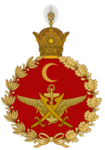 Seal of the Çakari Armed Forces
 -
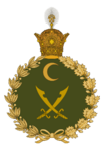 Seal of the Çakari Ground Forces
 -
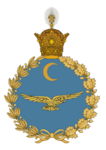 Seal of the Çakari Air Force
 -
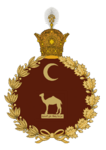 Seal of the Çakari Border Guard with its motto: "Vigilant guard at the border" (Arboric: حراسة يقظة على الحدود)
 -
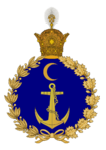 Seal of the Çakari Navy
 -
 Seal of the Defensive Missile Troops
 -
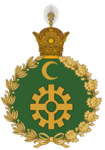 Seal of the Logistical Support Troops
 -
 Seal of the Sagittarius Guard with its motto: "Do not fight without honor or reason" (Babkhi: بدون شرف و دلیل دعوا نکنید)
 -
 Seal of the Kyazilkai Guard
Military districts
Military districts are largely divided according to State boundaries. Only the Antican Military District includes parts of Barikalus, Kendall Khanate and Sylfystan. The Tennyn Subah is part of two military districts, the Eastern Military District and the Silfanya Military District. Taka'atui is assigned to the Eastern Military District through a firman (imperial decree).
| Shield | District | HQ | Fleet/Flotilla | Map | |
|---|---|---|---|---|---|

|
Antican Military District | Suryapur | Antican Fleet | 
| |

|
Chattaan Military District | Portpur | Naarangee Fleet | ||

|
Eastern Military District | Madinat al-Fath | Pearl Fleet | ||

|
Khelaq Military District | Nyo Agra | Northern Fleet | ||

|
Monalan Military District | Akbarabad | Neela Flotilla | ||

|
Silfanya Military District | Manbai | Dayar Fleet | ||

|
Thul Military District | Jeevitchinar |
Former military district
| Shield | District | HQ | Fleet/Flotilla | Notes | |
|---|---|---|---|---|---|

|
Jaihabar Military District | Mathura | Austral Fleet | This district was founded in 1722 AN until the withdrawal from Corum. |
Personnel
| Çakari Armed Forces | ||||
|---|---|---|---|---|
| Active | Reserve | Governing Body | Area | |
 Çakari Ground Forces Çakari Ground Forces |
1,200,000 | 2,700,000 | Vizarat al-Harb | |
 Çakari Navy Çakari Navy |
67,000 | 160,000 | ||
 Çakari Air Force Çakari Air Force |
140,000 | 230,000 | ||
 Çakari Border Guard Çakari Border Guard |
81,000 | Çakar-Floria border | ||
 Defensive Missile Troops Defensive Missile Troops |
21,000 | |||
 Logistical Support Troops Logistical Support Troops |
32,000 | |||
| 1,541,000 | 3,090,000 | |||
Ranks and Insignia
The rank insignia of commissioned officers:
| Rank group | General / flag officers | Senior officers | Junior officers | |||||||||||||||||||
|---|---|---|---|---|---|---|---|---|---|---|---|---|---|---|---|---|---|---|---|---|---|---|
| Rank code | OF-9 | OF-8 | OF-7 | OF-6 | OF-5 | OF-4 | OF-3 | OF-2 | OF-1 | OF-B | OF-C | |||||||||||
| Çakari Ground Forces
|

|

|

|

|

|

|

|

|

|

|

| |||||||||||
| ارتشبد Arteshbod General |
سپهبد Sepahbod Lieutenant general |
سرلشکر Sarlashkar Major general |
سرتیپ Sartip' Brigadier general |
سرهنگ Sarhang Colonel |
سرهنگ دوم Sarhang dovom Lieutenant colonel |
سرگرد Sargord Major |
سروان Sarvān Captain |
ستوان یکم Sotvān yekom First lieutenant |
ستوان دوم Sotvān dovom Second lieutenant |
ستوان سوم Sotvān sevom Third lieutenant | ||||||||||||

|

|

|

|
|||||||||||||||||||
| Çakari Navy
|

|

|

|

|

|

|

|

|

|

|

| |||||||||||
| دریابد Daryabod Admiral |
دریاسالار Daryasalar Vice admiral |
دریابان Daryaban Rear admiral |
دریادار Daryadar' Commodore |
ناخدا یکم Nakhoda yekom Captain |
ناخدا دوم Nakhoda dovom Commander |
ناخدا سوم Nakhoda sevom Lieutenant commander |
ناوسروان Navsarvan Lieutenant |
ناوبان یکم Navban yekom Lieutenant (junior grade) |
ناوبان دوم Navban dovom Ensign |
ناوبان سوم Navban sevom Ensign junior grade | ||||||||||||

|

|

|

|
|||||||||||||||||||
| Çakari Air Force
|

|

|

|

|

|

|

|

|

|

|

| |||||||||||
| ارتشبد Arteshbod General |
سپهبد Sepahbod Lieutenant general |
سرلشکر Sarlashkar Major general |
سرتیپ Sartip' Brigadier general |
سرهنگ Sarhang Colonel |
سرهنگ دوم Sarhang dovom Lieutenant colonel |
سرگرد Sargord Major |
سروان Sarvān Captain |
ستوان یکم Sotvān yekom First lieutenant |
ستوان دوم Sotvān dovom Second lieutenant |
ستوان سوم Sotvān sevom Third lieutenant | ||||||||||||

|

|

|

|
- | - | - | - | - | - | - | ||||||||||||
Paramilitary Forces
Several paramilitary forces exist within Çakaristan, primarily to provide military police services in various states. These paramilitary forces can be added to the Çakari Armed Forces in times of a national threat. Overview of paramilitary forces:
| Paramilitary Forces | ||||
|---|---|---|---|---|
| Active Strength | Governing Body | Area | ||
 Apollonian Security Assistance Force (ASAF) Apollonian Security Assistance Force (ASAF) |
classified | Secretary-General of ASAF | by mandate | |
 Archdiocesan Arcadian Guard Archdiocesan Arcadian Guard |
1,940 | Archbishop of the Eastern Apollonian Catologian Church | Leylpur | |
 Bulqan Chivalrous Guard Bulqan Chivalrous Guard |
70,000 | King of Bulqan | Kingdom of Bulqan | |
 Cobalt Blue Legion Cobalt Blue Legion |
2,800 | Nayib al'Amir | Emirate of Barikalus | |
 Congressional Mahal Guard Congressional Mahal Guard |
classified | Mutahadith | Grounds and buildings of the Çakari Congress | |
| हरियालीकेरक्षक (Hariyaalee-ke-rakshak) Defenders of the green |
155,880 | Chhatrapati of Haritdesh | Haritdesh Confederacy | |
| Khanate Marshalcy | 50,000 | Khan of Kendall Khanate | Kendall Khanate | |
| Korhalistan Marshalcy | 72,000 | Raja of Korhalistan | Korhalistan Rajya | |
 Kyazilkai Guard Kyazilkai Guard |
classified | Shahanshah of Çakaristan | Bodyguard and ceremonial duties | |
| Kyazilkai Rangers | 5,000 | Khagan of Kyazilkai | Kyazilkai Khaganate | |
 Sagittarius Guard Sagittarius Guard |
1,850 | Governor of Naudia'Diva | Governate of Naudia'Diva | |
| Nuristan Marshalcy | 2,000 | Sultan of Nuristan | Sultanate of Nuristan | |
| Redheart Troops | 45,000 | Raja of Poorajangal | Poorajangal Rajya | |
| Sikatadesh Sentinel Corps | 17,000 | Raja of Sikatadesh | Sikatadesh Rajya | |
| Sri Pashana State Troopers | 150,000 | Governor of Sri Pashana | State of Sri Pashana | |
| Sunehra Golden Guards | 7,900 | Raja of Sunehra | Sunehra Rajya | |
| Suqutra Military Police | 12,000 | Sultan of Suqutra | Sultanate of Suqutra | |
| Valesia Constabulary | 850 | Raja of Valesia | Valesia Rajya | |
Equipment
The Çakari Armed Forces are equipped with a diversity of equipment. During the Sylvanian National Awakening the unofficial armed forces had access to small equipment, mainly firearms and light vehicles. A large arsenal of weapons was given by the Emir of Arbor, weapons that came from Stormark. As the independence struggle progressed, they obtained more and more equipment from the Krasnocorian Armed Forces.
Immediately after independence, the state began building a military industry. For this purpose, already existing companies were placed under state control and new companies were established. Examples include Yurish Group and Rifle Factory Raoti.
After the annexation of Barikalus, much of the former Frankish equipment was incorporated into the arsenal. Through the second treaty with Batavia, other Frankish equipment was transferred to Çakaristan. With the annexation of Taka'atui, former equipment of the Thraci Confederation was transferred.
In 1731 AN, equipment was acquired from Sanpantul, including Ciric equipment. In the same year, two type aircraft were bought from the Sanaman Brightworks Mistra.
| ||||||||||||||||||||||||||||||||||||||||||||||||||||||||||||||||||


