
Sovereign Confederation
| The Sovereign Confederation of Governorates | |||
| |||
| Motto: Wield Power Without Abuse | |||
| Anthem: Ode to Gold | |||

| |||
| Map versions | n/a | ||
| Capital | Underwall | ||
| Largest city | Avakair | ||
| Official language(s) | Praeta, Istvanistani, Wintergleamish, Suthric | ||
| Official religion(s) | Cortallian Cedrism, Suthra, and Boomism | ||
| Demonym | Sovereign (official), Sovo (informal) | ||
| - Adjective | Sovereign (official), Soveï (informal) | ||
| Government | Confederated Open-Anocracy | ||
| - Szodan of the Realm | Miþuï Custodianship | ||
| - Uvngætz | Tenia Zuderson | ||
| - Legislature | The Miþuï | ||
| Establishment | 1671 AN Independence
1681 AN Admission into Elwynn 1703 AN Reorganized within the Benacian Union 1734 AN Document of Governance is amended through the Omnibus Reforms | ||
| Area | NA | ||
| Population | 44,454,691 (1723 AN) | ||
| Active population | 1 | ||
| Currency | Benacian Sovereign | ||
| Calendar | |||
| Time zone(s) | CMT -7 | ||
| Mains electricity | |||
| Driving side | |||
| Track gauge | |||
| National website | |||
| National forum | |||
| National animal | 12-Pointed Buck | ||
| National food | Remembrance Borscht | ||
| National drink | Charred Wine | ||
| National tree | Ironwood | ||
| Abbreviation | SC or SCG (most common) CSN (FMF abbreviation) | ||


The Sovereign Confederation of Governorates is a Realm of the Benacian Union, established in its current form in 1703 AN following its accession from the defunct Elwynnese state. Originally founded as an independent nation in 1671 AN under the direction of Ryker 001—a compu-mechanical copy of Ryker Everstone's consciousness—the Confederation was counted among the so-called vulture states of Benacia during the Kalirion Fracture.
The young nation struggled with financial instability and security concerns throughout the 1670s, leading to its annexation by Elwynn as an Autonomous Republic in 1681 AN. The catastrophic Scouring of 1698-1703 AN, which destroyed the capital at Kingsgate and the port city of Tephal through nuclear strikes, shattered what remained of Elwynnese authority. In 1703 AN, during the second session of the Congress of Chryse, the Sovereign Confederation secured recognition as a co-equal member realm within the newly formed Benacian Union.
Since accession, the Confederation has become deeply integrated with the Union's surveillance-industrial complex. By 1709 AN, the Miþuï—the Confederation's legislative chamber—acquired control of the Commission for the Panopticon, subjecting the realm's population to comprehensive surveillance in exchange for enhanced security and social benefits. Under the leadership of President Brugen Aldef (1703-1729 AN), the government pursued aggressive centralization while the Miþuï transformed from a purely legislative body into an increasingly powerful judicial institution. The entire governance structure was fundamentally reformed through the Omnibus amendments of 1734 AN, which codified the Miþuï's supremacy and established the Confederation's unique system of open anocracy.
History
Foundation and the Ryker OS Era (1671-1681)
The Sovereign Confederation emerged from the chaos of the Kalirion Fracture in 1671 AN, proclaimed by Ryker 001, a digital reconstruction of the late King Ryker Everstone's consciousness. Following Everstone's biological death, his most ambitious and financially extravagant projects collapsed, triggering a rapid economic implosion across the territories of old Goldshire. The financial house of cards that had precariously sustained the kingdom's mega-ventures toppled with impressive speed, leaving much of the populace disillusioned with the exceptionalism their late king had promised.
The early Confederation, officially titled the "Sovereign Confederation of Suthergold, Norestria, and Holwinn," controlled a truncated territory compared to the former Kingdom of Goldshire. Two territorial partitions foisted upon the national consciousness during this period further eroded public confidence. As government functions fell victim to mismanagement and corruption, a culture of apathy and stagnation spread across the populace.
The concept of governance by an artificial intelligence—the "decanting" of Everstone's cognitive functions into a simulated recreation of his neural pathways—proved difficult for authorities to explain and impossible for most citizens to comprehend. Public reaction ranged from mocking derision to outraged violence. The breakdown of the Ryker OS lineage dismantled the cult of personality that Everstone had brutally cultivated, leading to a crisis of legitimacy as the regime's claim to be the successor of Goldshire burned on the world stage.
As the years wore on, however, a wave of nostalgia for the rigid security under Everstonian law and order took hold, particularly in urban centers. This sentiment first manifested in Elsenar under the Iron Company, then suddenly erupted in Suthergold and the region surrounding Ketsire in Wintergleam under Doir Jen Mera, who proclaimed herself the daughter and voice of Ryker Everstone.
By 1681 AN, facing near-total financial collapse and growing security threats, the Sovereign Confederation forfeited its independence to Elwynn, becoming an Autonomous Republic. The Confederation ceded most of Holwinn to Ransenar as part of the arrangement, but gaining all it's northern claims on joinniig Elwynn.
The Elwynnese Period (1681-1698)
The arrangement with Elwynn gave the Confederation time and security to begin rebuilding trust in national institutions. Speaker Doir Jen Mera emerged as the de facto leader during this period, serving as spokeswoman and interlocutor between the bewildered populace and the Ryker OS. To soothe rural populations prone to viewing anything outside their limited experience as heretical, administrative authorities quietly shifted their rhetoric. Technical jargon regarding "operating systems" and "decanting" gave way to mystical language about the late King's "ascension" and "elevated consciousness." While never claiming full apotheosis, the regime increasingly associated the "Ever-Watching King" with Mors, Viviantia, and the Celestial Temple.
This period also saw the restoration and legitimization of the Assayers in 1675 AN under Speaker Doir's initiative. Though controversial given their role in the Goldshirean Civil War, the Assayers provided access to comprehensive banking systems that would prove crucial to the Confederation's future economic development.
The relative stability of the Elwynnese period allowed for modest economic recovery, though the Confederation remained financially troubled and dependent on the larger Elwynnese state.
The Scouring (1698-1703)
The Second Elwynnese Civil War brought catastrophe to the Sovereign Confederation. In what became known as the Scouring, antimatter weapon strikes obliterated Kingsgate and Tephal, two of the Confederation's oldest and largest cities. Millions of Sovereigns perished in the attacks and subsequent fallout. The capital at Kingsgate—which had served not only as the seat of government but as the cultural and educational center of the Sutherathasian people—was completely destroyed, leaving a devastated Exclusion Zone.
The nuclear attacks claimed the lives of key leadership including Speaker Doir Jen Mera, Johen Rinsley Brines, and Selardi Jen Daniyal. With no clear chain of command and the Ryker OS apparently non-functional, local bailiwick governments were left to fend for themselves. The breakdown in central authority, coupled with supply shortages from destroyed infrastructure and the loss of trading capacity on both the Elwynn River and eastern coast, pushed many communities to the brink of anarchy.
In the absence of functioning government, local officials collectively reinterpreted laws and references to the Ryker OS through mystical and religious lenses rather than attempting to navigate a mechanical bureaucracy that showed no signs of functioning. Religious organizations filled the power vacuum, catalyzing a modest Cedrist revival. The Cult of the Sacred Detonation in particular became stewards and de facto administrators of the most severely affected areas.
Though the Sovereign Confederation Autonomous Republic emerged as Pyrrhic victors from the war, the complete loss of Kingsgate and Tephal, the deaths of millions, and the collapse of government authority set the Confederation on an inevitable path away from the Elwynnese rump state.
Accession to the Benacian Union
In early 1702 AN, after nearly eight years of silent martial law, the Miþuï (previously a ceremonial representative council) had radio broadcasts resumed. The broadcasts sporadically announced a coming "Great Reversion" in which the Sovereign Confederation would be made whole through return to "the old ways". By the beginning of 1703 AN, it was announced that the Miþuï had been fully restored and had chosen a new Ænst Szonst to preside: Xander Jen Johannes, a politician who leaned into his history as a "conscientious-deserter" from republican forces.
A taskforce drawn from the Guild of Magisters-Carnifex, supported by four regiments of demobilized UDF and Elwynnese Landstorm veterans, was assembled in the third month of 1703 AN to locate the source of the broadcasts and bring Johannes to Chryse. There, he would confer with the High Presidium of the Benacian Union regarding the Sovereign Confederation's status.
During the second session of the Congress of Chryse in 1703 AN, Johannes successfully argued for the Confederation's admission as a co-equal member realm within the Benacian Union. The accession formalized the Confederation's separation from the moribund Elwynnese government and granted it full realm status within the emerging Union-State.
The Panopticon Reforms (1703-1729)
The first decade following accession was marked by aggressive institutional development under the leadership of Brugen Aldef, Speaker from Ketsire and leader of the dominant faction within the Miþuï. As the sole functioning institution of government, the Miþuï expanded its role far beyond its original legislative mandate.
In 1709 AN, the Miþuï acquired the office of Representative-Commissioner for the Panopticon, with Aldef assuming the position. This proved the pivotal moment in the Confederation's development. Aldef leveraged his dual role as Miþuï leader and Panopticon Commissioner to implement comprehensive surveillance across the realm, arguing that total transparency was necessary for effective governance and security.
By 1711 AN, work had begun on restoring the "Compufactory" that had created and maintained the Ryker OS, with the goal of resuming Sovereign chip-manufacturing capabilities. That same year, the Miþuï convened in special session to formally claim the powers of the vacant Szodan office for itself. This declaration of legislative supremacy, though controversial, faced little organized resistance given the absence of any alternative authority structure.
Aldef's administration pursued a campaign against remnants of Imperial-era nobility, confiscating assets from those who resisted integration into the new order. The proceeds from these confiscations were used to establish an annual basic income for Miþuï Speakers, further cementing the chamber's institutional independence.
Throughout the 1710s and 1720s, centralization accelerated. The Miþuï's relationship with the Panopticon deepened, creating what critics called a "surveillance-industrial complex" at the heart of Sovereign governance. The population accepted comprehensive monitoring in exchange for enhanced social benefits, personal freedoms for law-abiding subjects, and improved security.
Aldef's presidency became increasingly entrenched as the decade wore on, raising questions about the Confederation's adherence to Nationalist & Humanist principles. The Miþuï itself transformed during this period, evolving from a purely legislative chamber into an increasingly judicial body with growing influence over Union-level policy through its transparency agreements with the Congress of Chryse. In 1729 , however, Aldef resigned from the presidency, creating a succession crisis that would lead directly to the drafting of the Omnibus.
The Omnibus Reforms (1729-1734)
Following Aldef's resignation, the Confederation's governance structure underwent fundamental examination. The question of governmental obligations and their alignment with Nationalist & Humanist dogma dominated political discourse. The Miþuï, having wielded executive power for over two decades, needed formal constitutional grounding for its expanded role.
This period of reflection culminated in the comprehensive Omnibus reforms promulgated through Congressional Edict during the eighth session of the Congress of Chryse in 1734 AN. The Omnibus of the Documents of Governance codified the Confederation's unique system of "open anocracy"—a term describing the peculiar balance between total surveillance transparency and localized sovereign autonomy.
The reforms established four foundational documents defining territorial integrity, the four branches of state power (Miþuï, Staggusgæta, Gæta uis Korïaneï, and Szodanadtz), trial procedures under common law, and strict amendment protocols. The Omnibus enshrined the principle that the Confederation exists as a "partnership of sovereigns dedicated to Human Supremacy and Prosperity," rather than a traditional nation-state.
Crucially, the reforms formalized the Miþuï's supremacy, granting it the right to collectively wield any power of the Szodanadtz by majority vote. The office of Szodan itself was redefined as an emergency executive position, largely dormant except in crisis, with its powers held in trust by the Miþuï.
The Omnibus also established the rigid system of "Immutable Law" versus dynamic Congressional Edicts, allowing the constitutional framework to remain stable while permitting administrative adaptation through super-majority legislation.
Modern Period (1734-Present)
Since the Omnibus reforms, the Sovereign Confederation has operated under a stable, if unconventional, governmental system. The Miþuï continues to function as the supreme institution, conducting decennial "Class" elections under the Reformed Electoral Edict. These elections are managed through the Chamber of Guilds and Corporations, with individual Speakers sorted into the Ras Ufrus and Fænn party blocks through a ritualized "Draft" process to ensure legislative stability.
The Confederation's economy has diversified and grown, with the textile industry booming and major urban development in Doir, Underwall, and Avakair. The completion of the Sovereign Bureau building in 1729 AN and the Miþuï Building renovation that same year symbolized the institutional confidence of the modern state.
The relationship with the Panopticon remains central to Sovereign governance, with the realm continuing to subject its population to some of the most comprehensive surveillance regimes in the Benacian Union in exchange for social benefits and enhanced civil liberties for compliant subjects.
Government
The Sovereign Confederation of Governorates operates as a unique political entity within the Benacian Union, blending elements of legislative supremacy, surveillance-based governance, and distributed sovereignty. The political system centers around the Miþuï, the Confederation's legislative chamber, whose Speakers historically holds supreme authority and wields most executive and judicial powers collectively, alongside the Sovereign Szodan, during periods of unified government.
The most significant development in Sovereign governance occurred in 1709 when the Miþuï acquired the Commission for the Panopticon from the Congress of Chryse under the leadership of the Confederation's only president and first Uvngætz: Brugen Aldef. Aldef's reforms enhanced the Miþuï's judicial role and culminated in the 1711 Declaration that effectively granted the chamber the powers of the Sovereign Szodan. His administration's campaign against remnants of Imperial-era nobility led to widespread confiscation of assets from those resistant to reform; property from these confiscations are managed by Zælkrupp to provide base-income for Speakers.
The Confederation's model is distinguished by its integration with a comprehensive mass surveillance system operated through the Commission for the Panopticon and its enforcers in the Corps of the Gentlemen-at-Cudgels. This arrangement enables the state to maintain extensive oversight while simultaneously granting enhanced personal freedoms and socio-economic benefits to subjects who demonstrate consistent law-abiding behavior. Within the Confederation, the system represents an attempt to balance authoritarian surveillance capabilities with accountability through publicly transparent democratic processes. The longevity of its Commission is often attributed to its stewardship of the Corps which, as executors of a continent-spanning security/surveillance infrastructure, maintains a light touch in law-enforcement relative to local counterparts.
Historically, the Confederation evolved from the remnants of the autocracy of the last King of Goldshire and was influenced by Nationalist & Humanist principles in its infancy, following separation from Shireroth. An alliance between central-Wintergleam, western Suthergold, and short-lived Norestria (now the Governorate of Asantelian) persisted through various political upheavals, including antimatter weapon strikes and subsequent periods of martial law. Despite these challenges, federal elements remain integral to the Confederation's structure, with discretionary powers at the bailiwick and governorate levels leaving wide gaps between how any two systems would process justice for the same crime or uphold their laws.

The latest reforms, codified in the Omnibus of the Documents of Governance (1734), establish four branches of state power:
- The Miþuï - Supreme legislative, executive, and judicial authority comprising Speakers elected from each bailiwick
- The Staggusgæta - Executive council headed by the Uvngætz (appointed by the Szodanadtz and confirmed by the Miþuï) responsible for day-to-day administration
- The Gæta uis Korïaneï - Advisory and policy council, also headed by the Uvngætz, that prepares directives and legislation
- The Szodanadtz - Executive-judiciary under the authority of the Sovereign Szodan, which may be held in custodianship by the Miþuï
Subdivisions

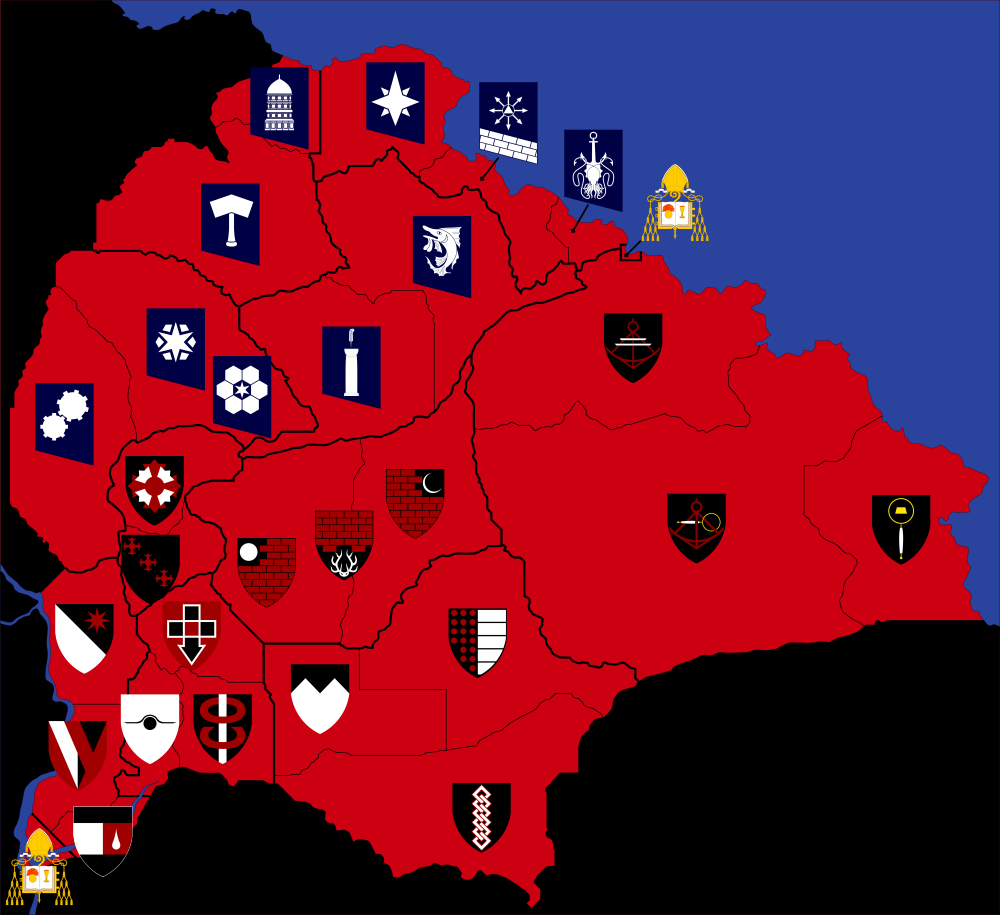
Following independence and finalization of borders with neighboring states during the Fracture, the Sovereign Confederation reorganized itself into 38 bailiwicks along historic and ethno-cultural lines. These borders remained unchanged during the state's time as an Elwynnese Autonomous Republic. During the process of accession to the Benacian Union, depopulated or otherwise devastated bailiwicks were either folded into larger neighbors or designated as unfit for civilian residence. The remaining bailiwicks were organized into 10 Governorates, plus the Kingsgate and Tephal Exclusion Zones.
In its first 40 years, the Confederation's Governorships were often left vacant for fear of secession. This left bailiwicks to deal directly with the realm government, and slowly led to the rise of the Miþuï as the axiom of governance from its reforms of 1711 until the mid 1730s. In that time, most gubernatorial seats were filled through Miþuï elections among those Speakers representing the bailiwicks of the governorate in question. Their appointment is now delegated to the Szodan following a succession of proceedural and structural reforms since the adoption of the Omnibus.
| Governorates | Circuit | Meritorious Subjects | Subjects Without Merit | Total | |
|---|---|---|---|---|---|
| Juveniles | Protected Persons | ||||
| Capital | SG | 1,765,356 | 1,140,074 | - | 2,905,430 |
| Cortallia-Rathwood | SG | 2,419,045 | 498,472 | - | 2,917,517 |
| Everstone | SG | 12,308 | 6,678 | 869,980 | 876,658 |
| Sutherland | SG | 1,002,109 | 349,709 | 53,327 | 1,405,145 |
| South Temple | SG | 934,152 | 339,680 | 86,348 | 1,360,180 |
| Asantelian | SG | 4,523,738 | 1,780,302 | - | 6,304,040 |
| Ketshire | WG | 2,139,560 | 657,479 | 360,023 | 3,157,062 |
| Durow | WG | 310,126 | 130,219 | - | 440,345 |
| Norburg | WG | 464,281 | 202,132 | - | 666,413 |
| The Wintergleam | WG | 1,420,129 | 781,427 | - | 2,201,556 |
| Szodansdron | ED | 2,237 | 734 | 46,551 | 49,522 |
| Tephal | ED | 4,201 | 26 | 20,042 | 24,269 |
| Total | 14,997,242 | 5,874,624 | 1,436,271 | 22,308,137 | |
| Governorates | Circuit | Meritorious Subjects | Subjects Without Merit | Total | |
|---|---|---|---|---|---|
| Juveniles | Protected Persons | ||||
| Capital | S | 2,886,127 | 1,586,649 | - | 4,472,776 |
| Cortallia-Rathwood | S | 2,659,093 | 668,472 | - | 3,327,565 |
| Everstone | S | 19,720 | 17,731 | 940,608 | 978,059 |
| Sutherland | S | 1,460,970 | 363,602 | 120,477 | 1,945,049 |
| South Temple | S | 1,194,282 | 422,349 | 74,581 | 1,691,212 |
| Asantelian | S | 5,256,991 | 1,776,226 | - | 7,033,217 |
| Ketshire | W | 4,275,134 | 1,124,512 | 59,674 | 5,399,646 |
| Durow | W | 510,421 | 242,718 | - | 753,139 |
| Norburg | W | 577,275 | 251,325 | - | 828,600 |
| The Wintergleam | W | 1,664,594 | 791,612 | - | 2,456,206 |
| Szodansdron | ED | 99,707 | 892 | 72,265 | 172,864 |
| Tephal | ED | 20,672 | 926 | 34,988 | 56,586 |
| Total | 20,624,986 | 7,247,014 | 1,302,593 | 29,114,919 | |
Circuit Designations:
- SG - Suthergold Alïuftrazd
- WG - Wintergleam Hringaríki
- ED - Exclusion Diocese
The substantial population growth between 1712 and 1723 AN—from approximately 22.3 million to 29.1 million subjects—reflects post-war recovery, immigration from other Benacian territories, and the reintegration of displaced populations following the stabilization of the Exclusion Zones.
The Omnibus and Other Law
The Omnibus of the Documents of Governance functions as the "Immutable Law" of the Confederation. Unlike statutory legislation, the Omnibus establishes the ontological status of the realm as a partnership of sovereigns dedicated to Human Supremacy and Prosperity. It is divided into four documents that define the territorial boundaries, the four branches of state power, the trial procedures of the common law, and the strict protocols for amendment. The Omnibus is designed for extreme durability; its provisions regarding the inviolability of territory and the "omnipresence" of the Panopticon form the moral and legal bedrock of Benacian civilization within the realm.
While the Omnibus defines the structure of the state, Congressional Edicts serve as the dynamic instruments of governance. These acts, passed by a 5:7 majority (65 votes) in the Miþuï, translate constitutional theory into administrative reality. The most significant example is the Reformed Electoral Edict, which manages the decennial "Class" elections. This edict regulates the Chamber of Guilds and Corporations' sponsorship of candidates, sets the market price for additional votes, and governs the "Draft" process—the ritualized assignment of individual Speakers into the Ras Ufrus and Fænn party blocks to ensure legislative stability.
The relationship between the Omnibus and the Edicts is one of hierarchy and delegation. The Omnibus provides the mandate for an institution to exist, while an Edict provides that institution with its specific instructions for a given decade. For example, Document Two of the Omnibus mandates that the Miþuï must hold elections; however, it is a Edict that creates the "Loser's Rebate" and the right to purchase votes. This allows the Staggusgæta to adapt the realm's political economy to shifting social or technological landscapes without needing to undergo the arduous process of amending the Omnibus.
Society
The Confederation's flat geography and location along the borderlands between the old Goldshirean and Elwynnese imperial states defines its modern blend of cultural identities and peculiar political philosophies. The entire region has been subjected to several periods of mass immigration, and yet in spite of these diverse demographics, there are some common threads shared by most Sovereigns which serve as stabilizing forces within the young confederation. Such traits include meritocratic ideals rooted in Elwynnese republican experiments of the 17th century in Wintergleam and Rykerist entrepreneurial populism in Suthergold. Also shared among Sovereigns is a deep-seated reverence for cultural integrity and preservation of fellow subjects' heritage, existing as an unspoken social contract of mutual respect and dignity. The Sovereign Confederation has been able to leverage these traditions of the previous century to forge a path of aggressively balanced cooperation between the realm's various immigrant populations, sponsored by philanthropic contributions from wealthy private and corporate donors.
Since the Commission for the Panopticon was granted to the Miþuï in 1709 AN, the total surrender of Sovereign privacy has been tolerated by the populace, as greater personal freedoms and certain socio-economic benefits are afforded to those observed displaying consistent law-abiding behavior.
Cultural Groups

The Sutherathasians
Making up the largest share of the Sovereign population even after the Scouring, the Sutherathasians are descended from central-Benacian clans first brought to Goldendown, and later Suthergold by Ryker following his ascension to the Countship in the early 1600s, where they settled along its western riverine shores. Owing to their varied origins, and the consistent and guiding patronage in early years from the County Government, the first sponsored settlements managed to spread eastward to the Halberd Coast over the course of just a few years. This rapid expansion and almost militant cultural xenophilia was bolstered by integration with the sparse Treesian-descended populace and directly led to Duke Merkayastreb's approval of the creation of Suthergold. The Praetan tongue was soon after adopted by the entire county's Sutherathasian populace, and continues as a commonly learned second-language across the Confederation. The second generation of settlers saw their numbers further bolstered by an influx of refugees from the political turmoil and violence across Shireroth, particularly Elwynn. Having experienced such a degree of favor from their patron in Kingsgate and grateful for their newfound prosperity, the Sutherathasians were fiercely loyal to the Everstone regime throughout its various iterations until the glaring and sustained failings of the RykerOS experiments. The Kalirion Fracture provided the disproportionately wealthy and more urbanized subjects within the territory of Suthergold the opportunity to go a separate path from the rest of Goldshire as a confederate union between Sutherathasians and Wintergleamers. The violent and total loss of Kingsgate, which had served not only as seat of their county government, but as the center of culture and learning for the Sutherathasian people, crippled their spirit until the end of the turn of the century and fueled the fires in the hearts of their outraged youth, who went on to reforge the confederation on equal footing with the other Sovereign peoples.
Sutherathasians are mostly concentrated around Cortallia-Rathwood, High Harvest, New Harbor, and Underwall.

The Wintergleamers
The Wintergleamers dominate every bailiwick in the territories within their circuit, save Dravotih iker, in which they are merely a plurality among the bailiwick's diverse population from across northern Benacia. They migrated to the western corner of their modern homeland from Storish hunting and trapping colonies in Araxion in the 15th century and then in a second wave to the eastern shores from the Storish mainland in the early 16th century. By the mid-1500s, the viking lords who reigned over these lands were exiled by the Golden Mango Throne for their hostile discrimination against non-Storish subjects, leaving the settlers to diverge on their own path of Nordic Benacian culture. During the tyrannical reign of the Harald Entity in the mid-17th century, an unprecedented deluge of Storo-Vanic migration threatened to supplant the diverse cultures and peoples of all northern Elwynn. Even the cultural similarities between Vanics and Wintergleamers did not shield them from forced indoctrination into the Haraldic Cult, nor their lands from uncompensated reappropriation. The Auspicious Occasion, though successful in halting this process of genocide, also divided Wintergleamers between the Elwynnese rump-state and the Kingdom of Goldshire as a means to oversee the de-colonization of those lands most affected by the generation of Vanic incursion. This division, though briefly rectified, resumed until 1681 AN, when the Sovereign Confederation assumed control over Wintergleam and integrated the Wintergleamers fully as an equal partner in government with the people of Suthergold.
The Asantele
The Asantele inhabit the eastern coast of the Suthergold circuit and form a majority of the population there outside of New Harbor. Tradition dictates that their origins trace back to ancient seamen of Raikoth, the Aphakian tribe in particular, who sought fertile pastures and warmer waters and were later bound to the land under the Khaz Modan. Their County of Asantelian existed within Goldshire until the beginning of the 17th century when it was formed into Suthergold through unification with Goldendown to the west. The hill country located just inland along the coast kept most Asantele on the water in tight-knit communities, though in their larger towns and cities, societies evolved into complicated webs of familial obligations, bonds, and political alliances. Nowhere are the products of this development more evident than Avakair, from where the Assayers originated and were often able to manipulate such entrenched systems of loyalty to gain considerable power and influence in the economic machinations of the Imperial Republic, Goldshire, and Suthergold. In the decades following the formation of the Sovereign Confederation, the Asantele have managed to form a united front and act as a power broker through the offices provided to legislators from within their uniquely structured governorate. The loss of Tephal to the Scouring severely damaged ancient canal infrastructure to the northern pastures of Asantelian, leading to a brief but sizeable migration of Asantele into Dravotih iker and New Harbor.
Smaller Groups

The Holwinnese
The people of the Hol Winn are said to be the millennia-removed progeny of Raynor Me'Jiliad's daemon-slaying army and live along the Confederation's lands on the banks of the Elwynn's river basin. In the Everstone Governorate and Szodansdron alike, the Holwinnese population from the southern river shore had developed communities and neighborhoods just beyond the Kingsgate city limits to enjoy lower cost of living while being able to work in the city. After the Scouring leveled the old capital, these suburban communities found themselves a much larger proportion of Everstone's population, terminally lacking its beating metropolitan heart. The ensuing looting ensured most survivors a criminal record by the time local governance resumed. In lieu of the burden of debt from legal fines and other processing costs or imprisonment, most were allowed to offer their labor in rebuilding the agricultural output potential along the rivers serving individually determined "voluntary sentences".

The Feyneblwd
Descended from the indigenous peoples of eastern Benacia, the modern Feyneblwd now live predominantly along a strip of ancient pastoral land reaching from the city of Meath in Ransenar to the bailiwick of Lowchurch in the southern reaches of the Confederation. Within the borders of Lowchurch, they exist as the dominant cultural and political block from their small ancestral villages and parishes. Keen to preserve their humble way of life, they are often loathe to participate in Sovereign politics or economic ventures, with the limited exception of fostering a highly regulated bed and breakfast tourism industry. During the reign of Ryker, the Feyneblwd's lands were peppered with small subterranean bunkers as a means to fortify the open countryside, though their disuse eventually led to local Cedrist clergymen converting several of the larger installations into temples, from which South Temple and Lowchurch derive their Istvanistani names.

The Sutherlanders
The Sutherlanders were, until the early 1600s, a small collection of pastoral tribes who existed outside the purview of the various east-Benacian polities which nominally presided over them throughout the preceding millennium. This insulation was a product of their ancient nomadic traditions which rendered them so transient between Wintergleam and its southern border that neither Goldshire nor Elwynn recognized them as a distinct entity until the census of old Goldendown undertaken by Count Everstone. The County government came to model much of its own initial governing ideals on their novel customs and arranged their permanent settlement in their own city and (later on) governorate of Sutherland. It wasn't until the Sovereign Confederation took on its modern borders that all Sutherlanders were truly united under a single government. They are renowned for their reverence for cosmic fortune and civil justice inspired by the legend of their founding-mother, Cortallia. The oral traditions are passed through their Suthric tongue, which has been adopted by much of Sovereign Academia as a prestige language.
The Meridionales
In the tumultuous years following the Kalirion Fracture, much of the south-Goldshirean county of Lunaris came under hostile occupation by the Guttuli Protectorate. Under their criminal pariah regime, Lunatics and Octoluners were subjected to discriminatory legislation and eventually outright ethnic violence. Those who escaped north settled first in Gran Verionia, before the new Martino-speaking generation saw its lands overcome by Ransenar and the still-independent Sovereign Confederation, as they feared possible Northern Lunaris' invasion. Those who managed as far as the Confederation were given a reserve in the grassy fields and ancient Greenwinter Forests of the Eastwall Bailiwick. Over the next few decades, the novelty of these refugees, these "Meridionales", brought in a steady stream of wealthy Sovereign and Ransenari tourists alike, all too eager to spend their time and money enjoying and enriching the self-aware absurdity of Lunatic customs. In 1716 AN, the eight largest settled families among the Meridionales adopted the Vade Mecum to govern their own bailiwick's affairs. This informal but de facto charter was adopted in localized forms across much of the Confederation soon thereafter, granting this small but captivating people a level of cultural influence akin to that experienced by the Sutherlanders.
Government
The Sovereign Confederation of Governorates within the Benacian Union is a unique political entity that blends authoritarian governance with corporate democratic oversight. It is distinguished by its integration with a comprehensive mass surveillance system, enhancing both governance and security apparatuses. The Confederation's political structure centers around the powers of the Szodan, an executive position that remains mostly inactive except in dire circumstances, with its powers held by the Miþuï, the Confederation's legislative chamber. This body is crucial to the Confederation's operation, holding significant legislative and executive powers, including oversight of the Commission for the Panopticon's surveillance data. This arrangement bolsters the Confederation's ability to maintain oversight and implement social control measures, positioning it as a key player in the Benacian Union's security and policy framework.
The political system of the Confederation is designed to marry the efficiency of total state-surveillance with the accountability of publicly traded democratic processes. It achieves this through the Miþuï's authority to monitor or potentially dismiss the Szodan and through a structured regional administration that ensures consistent policy implementation across the Confederation. This governance model is notable for its strategic use of AI-powered surveillance to underpin internal security while adhering to a balance between central control and individualist governance ideals.
Historically, the Confederation evolved from a paternal-autocracy influenced by the legacy of the last King of Goldshire and Nationalist & Humanist principles following its separation from Shireroth. It sought to avoid the pitfalls of previous federal systems, forming from a coalition of Wintergleam, western Suthergold, and the briefly existing Norestria (now the Governorate of Asantelian). The alliance persisted through various political upheavals, including antimatter weapon strikes and a subsequent period of martial law, which further facilitated the adoption of N&H governance principles. Despite these challenges, federal elements remain integral to the Confederation's structure, with a focus on centering executive powers at the bailiwick level to ensure effective governance.
Significant developments in the Confederation's governance include the Miþuï's acquisition of the office for the Commissioner for the Panopticon in 1709, led by then-President, Brugen Aldef. Aldef's reforms aimed to enhance the Miþuï's judicial role, culminating in a declaration that effectively granted it the powers of the Sovereign Szodan. This move, along with Aldef's campaign against remnants of the Imperial-era nobility, led to the confiscation of assets from those resistant to reform; the proceeds from which now fund an annual basic income for Miþuï Speakers.
Reasons for Independence
1671: Shortly after the disappearance of King Ryker Everstone from public life and subsequent biological death, most of his financially exorbitant projects were either placed on hold or abandoned. The financial house of cards that had precariously supported itself against these heavily subsidized mega-ventures toppled over with impressive speed. The ensuing decay in order coupled with two territorial partitions foisted upon the national consciousness left much of Goldshire disillusioned with their own supposed exceptionalism touted by their old King and allowed for a culture of apathy and stagnation to spread rapidly though across the entire populace. As the years wore on, however, and still more functions of government fell subject to mismanagement and corruption, a sense of nostalgia for the more rigid days of a heavily armed Goldshire took hold of populations, particularly in urban centers. This wave of sentimentality for the days of security under Everstonian law and order first took hold in Elsenar under the Iron Company and later, very suddenly, in Suthergold and the region surrounding Ketsire in Wintergleam under one Doir Jen Mera, daughter and self-proclaimed voice of Ryker Everstone.
1703: Though the SC Autonomous Republic emerged as Pyrrhic victors of another Elwynnese war, the complete loss of two of its oldest cities and millions of Sovereigns to the Scouring and war at large placed the confederation on a path to exit the Elwynnese rump-state. In the Second Congress if Chryse, an ultimately successful case was made to the young Benacian Union to mandate the Sovereign Confederation's accession as a Realm. The Miþuï began its unique relationship with the Panopticon shortly thereafter, subjecting the Sovereign Confederation's populace to regiments of near total surveillance.
Subdivisions
Following it's independence and finalization of borders with neighboring states during the Fracture, the Sovereign Confederation reorganized itself into 38 bailiwicks along historic and ethno-cultural lines; the borders of which remained unchanged during the state's time as an Elwynnese Autonomous Republic. Later, during the process of it's ascension to the Benacian Union, depopulated or otherwise devastated bailiwicks were either folded into larger neighbors or designated as unfit for civilian residence, as those remaining were organized into 10 Governorates, plus the Kingsgate and Tephal Exclusion Zones.
In its first 40 years, the Confederation's Governorships were often left vacant for fear of secession. This left bailiwicks to deal directly with the realm, and slowly led to the rise of the Miþuï as a legitimate tool of government. After the Panopticon reforms of 1711, gubernatorial seats are filled in Miþuï elections among those Speakers representing the bailiwicks of the governorate in question.
↑interactive map
| Governorates | Circuit | Meritorious Subjects | Subjects Without Merit | Total | |
|---|---|---|---|---|---|
| Juveniles | Protected Persons | ||||
| Capital | SG | 1,765,356 | 1,140,074 | - | 2,905,430 |
| Cortallia-Rathwood | SG | 2,419,045 | 498,472 | - | 2,917,517 |
| Everstone | SG | 12,308 | 6,678 | 869,980 | 876,658 |
| Sutherland | SG | 1,002,109 | 349,709 | 53,327 | 1,405,145 |
| South Temple | SG | 934,152 | 339,680 | 86,348 | 1,360,180 |
| Asantelian | SG | 4,523,738 | 1,780,302 | - | 6,304,040 |
| Ketshire | WG | 2,139,560 | 657,479 | 360,023 | 3,157,062 |
| Durow | WG | 310,126 | 130,219 | - | 440,345 |
| Norburg | WG | 464,281 | 202,132 | - | 666,413 |
| The Wintergleam | WG | 1,420,129 | 781,427 | - | 2,201,556 |
| Szodansdron | ED | 2,237 | 734 | 46,551 | 49,522 |
| Tephal | ED | 4,201 | 26 | 20,042 | 24,269 |
| Total | 14,997,242 | 5,874,624 | 1,436,271 | 22,308,137 | |
| Governorates | Circuit | Meritorious Subjects | Subjects Without Merit | Total | |
|---|---|---|---|---|---|
| Juveniles | Protected Persons | ||||
| Capital | SG | 2,886,127 | 1,586,649 | - | 4,472,776 |
| Cortallia-Rathwood | SG | 2,659,093 | 668,472 | - | 3,327,565 |
| Everstone | SG | 19,720 | 17,731 | 940,608 | 978,059 |
| Sutherland | SG | 1,460,970 | 363,602 | 120,477 | 1,945,049 |
| South Temple | SG | 1,194,282 | 422,349 | 74,581 | 1,691,212 |
| Asantelian | SG | 5,256,991 | 1,776,226 | - | 7,033,217 |
| Ketshire | WG | 4,275,134 | 1,124,512 | 59,674 | 5,399,646 |
| Durow | WG | 510,421 | 242,718 | - | 753,139 |
| Norburg | WG | 577,275 | 251,325 | - | 828,600 |
| The Wintergleam | WG | 1,664,594 | 791,612 | - | 2,456,206 |
| Szodansdron | ED | 99,707 | 892 | 72,265 | 172,864 |
| Tephal | ED | 20,672 | 926 | 34,988 | 56,586 |
| Total | 20,624,986 | 7,247,014 | 1,302,593 | 29,114,919 | |
The Omnibus and Other Law
The Omnibus of the Documents of Governance functions as the "Immutable Law" of the Confederation. Unlike statutory legislation, the Omnibus establishes the ontological status of the realm as a partnership of sovereigns dedicated to Human Supremacy and Prosperity. It is divided into four documents that define the territorial boundaries, the four branches of state power, the trial procedures of the common law, and the strict protocols for amendment. The Omnibus is designed for extreme durability; its provisions regarding the inviolability of territory and the "omnipresence" of the Panopticon form the moral and legal bedrock of Benacian civilization within the realm.
While the Omnibus defines the structure of the state, Congressional Edicts serve as the dynamic instruments of governance. These acts, passed by a 5:7 majority (65 votes) in the Miþuï, translate constitutional theory into administrative reality. The most significant example is the Reformed Electoral Edict, which manages the decennial "Class" elections. This edict regulates the Chamber of Guilds and Corporations' sponsorship of candidates, sets the market price for additional votes, and governs the "Draft" process—the ritualized siloing of individual Speakers into the Ras Ufrus and Fænn party blocks to ensure legislative stability.
The relationship between the Omnibus and the Edicts is one of Hierarchy and Delegation. The Omnibus provides the mandate for an institution to exist, while an Edict provides that institution with its specific instructions for a given decade. For example, Document Two of the Omnibus mandates that the Miþuï must hold elections; however, it is a Congressional Edict that determines the "Loser's Rebate" and the specific price of purchased votes. This allows the Staggusgæta to adapt the realm’s political economy to shifting social or technological landscapes without needing to undergo the arduous process of constitutional amendment.
Society
The Confederation's flat geography and location along the borderlands between the old Goldshirean and Elwynnese imperial states defines its modern blend of cultural identities and peculiar political philosophies. The entire region has been subjected to several periods of mass immigration, and yet in spite of these diverse demographics, there are some common threads shared by most Sovereigns which serve as stabilizing forces within the young confederation. Such traits include meritocratic ideals rooted in Elwynnese republican experiments of the 17th century in Wintergleam and Rykerist entrepreneurial populism in Suthergold. Also shared among Sovereigns is a deep-seated reverence for cultural integrity and preservation of fellow subjects' heritage, existing as a unspoken social contract of mutual respect and dignity. The Sovereign Confederation has been able to leverage these traditions of the previous century to forge a path of aggressively balanced cooperation between the realm's various immigrant populations, sponsored by philanthropic contributions from wealthy private and corporate donors.
More recently, in the years since the Commission for the Panopticon was granted to the Miþuï, the total surrender of Sovereign privacy has been tolerated by the populace, as greater personal freedoms and certain socio-economic benefits were afforded to those observed displaying consistent law-abiding behavior.
Cultural Groups
The Sutherathasians
Making up the largest share of the Sovereign population even after the Scouring, the Sutherathasians are descended from central-Benacian clans first brought to Goldendown, and later Suthergold by Ryker following his ascension to the Countship in the early 1600s, where they settled along its western riverine shores. Owing to their varied origins, and the consistent and guiding patronage in early years from the County Government, the first sponsored settlements managed to spread eastward to the Halberd Coast over the course of just a few years. This rapid expansion and almost militant cultural xenophilia was bolstered by integration with the sparse Treesian-descended populace and directly led to Duke Merkayastreb's approval of the creation of Sutehrgold. The Praetan tongue was soon after adopted by the entire county's Sutherrathasian populace, and continues as a commonly learned second-language across the Confederation. The second generation of settlers saw their numbers further bolstered by an influx refugees from the political turmoil and violence across Shireroth, particularly Elwynn. Having experienced such a degree of favor from their patron in Kingsgate and grateful for their newfound prosperity, the Sutherathasians were fiercely loyal to the Everstone regime throughout its various iterations until the glaring and sustained failings of the RykerOS experiments. The Kalirion Fracture provided the disproportionately wealthy and more urbanized subjects within the territory of Sutehrgold the opportunity to go a separate path from the rest of Goldshire as a confederate union between Sutherathasians and Wintergleamers. The violent and total loss of Kingsgate, which had served not only as seat of their county government, but as the center of culture and learning for the Sutherathasian people, crippled their spirit until the end of the turn of the century and fueled the fires in the hearts of their outraged youth, who went onto reforge the confederation on equal footing with the other Sovereign peoples.
Sutherathasians are mostly concentrated around Cortallia-Rathwood, High Harvest, New Harbor, and Underwall.
The Wintergleamers
The Wintergleamers dominate every bailiwick in the territories within their circuit, save Dravotih iker, in which they are merely a plurality among the bailiwick's diverse population from across northern Benacia. They migrated to the western corner of their modern homeland from Storish hunting and trapping colonies in Araxion in the 15th century and then in a second wave to the eastern shores from the Storish mainland in the early 16th century. By the mid-1500s, the viking lords who reigned over these lands were exiled by the Golden Mango Throne for their hostile discrimination against non-Storish subjects, leaving the settlers to diverge on their own path of Nordic Benacian culture. During the tyrannical reign of the Harald Entity in the mid-17th century, an unprecedented deluge of Storo-Vanic migration threatened to supplant the diverse cultures and peoples of all northern Elwynn. Even the cultural similiarities between Vanics and Wintergleamers did not shield them from forced indoctination into the Haraldic Cult, nor their lands from uncompensated reappropriation. The Auspicious Occasion, though successful in halting this process of genocide, also divided Wintergleamers between the Elwynnese rump-state and the Kingdom of Goldshire as a means to oversee the de-colonization of those lands most affected by the generation of Vanic incursion. This division, though briefly rectified, resumed until 1781, when the Sovereign Confederation assumed control over Wintergleam and integrated the Wintergleamers fully as an equal partner in government with the people of Suthergold.
The Asantele
The Asantele inhabit the eastern coast of the Suthergold circuit and form a majority of the population there outside of New Harbor. Tradition dictates that their origins trace back to ancient seamen of Raikoth, the Aphakian tribe in particular, who sought fertile pastures and warmer waters and were later bound to the land under the Khaz Modan. Their County of Asantelian existed within Goldshire until the beginning of the 17th century when it was formed into Suthergold through unification with Goldendown to the west. The hill country located just inland along the coast kept most Asantele on the water in tight-knit communities, though in their larger towns and cities, societies evolved into complicated webs of familial obligations, bonds, and political alliances. Nowhere are the products of this development more evident than Avakair, from where the Assayers originated and were often able to manipulate such entrenched systems of loyalty to gain considerable power and influence in the economic machinations of the Imperial Republic, Goldshire, and Suthergold. In the decades following the formation of the Sovereign Confederation, the Asantele of have managed to form a united front and act as a power broker through the offices provided to legislators from within their uniquely structured governorate. The loss of Tephal to the Scouring severely damaged ancient canal infrastructure to the northern pastures of Asantelian, leading to a brief but sizeable migration of Asantele into Dravotih iker and New Harbor.
Smaller Groups
The Holwinnese
The people of the Hol Winn are said to be the millennia-removed progeny of Raynor Me'Jiliad's daemon-slaying army and live along the Confederation's lands on the banks of the Elwynn's river basin. In the Everstone Governorate and Szodansdron alike, the Holwinnese population from the southern river shore had developed communities and neighborhoods just beyond the Kingsgate city limits to enjoy lower cost of living while being able to work in the city. After the Scouring leveled the old capitol, these suburban communities found themselves a much larger proportion of Everstone's population, terminally lacking its beating metropolitan heart. The ensuing looting ensured most survivors a criminal record by the time local governance resumed. In lieu of the burden of debt from legal fines and other processing costs or imprisonment, most were allowed to offer their labor in rebuilding the agricultural output potential along the rivers serving individually determined "voluntary sentences".
The Feyneblwd
Descended from the indigenous peoples of eastern Benacia, the modern Feyneblwd now live predominantly along a strip of ancient pastoral land reaching from the city of Meath in Ransenar to the bailiwick of Lowchurch in the southern reaches of the Confederation. Within the borders of Lowchurch, they exist as the dominant cultural and political block from their small ancestral villages and parishes. Keen to preserve their humble way of life, they are often loathe to participate in Sovereign politics or economic ventures, with the limited exception of fostering a highly regulated bed and breakfast tourism industry. During the reign of Ryker, the Feyneblwd's lands were peppered with small subterranean bunkers as a means to fortify the open countryside, though their disuse eventually led to local Cedrist clergymen converting several of the larger installations into temples, from which South Temple and Low church derive their Isvanistani names.
The Sutherlanders
The Sutherlanders were, until the early 1600s, a small collection of pastoral tribes who existed outside the purview of the various east-Benacian polities which nominally presided over them throughout the preceding millennium. This insulation was a product of their ancient nomadic traditions which rendered them so transient between Wintergleam and its southern border that neither Goldhire nor Elwynn recognized them as a distinct entity until the census of old Goldendown undertaken by Count Everstone. The County government come to model much of its own initial governing ideals on their novel customs and arranged their permanent settlement in their own city and (later on) governorate of Sutherland. It wasn't until the Sovereign Confederation took on its modern borders that all Sutherlanders were truly united under a single government. They are renowned for their reverence for cosmic fortune and civil justice inspired by the legend of their founding-mother, Cortallia. The oral traditions are passed through their Suthric tongue, which has been adopted by much of Sovereign Academia as a prestige language.
The Meridionales
In the tumultuous years following the Kalirion Fracture, much of the south-Goldshirean county of Lunaris came under hostile occupation by the Guttuli Protectorate. Under their criminal pariah regime, Lunatics and Octoluners were subjected to discriminatory legislation and eventually outright ethnic violence. Those who escaped north settled first in Gran Verionia, before the new Martino-speaking generation saw its lands overcome by Ransenar and the still independent Sovereign Confederation, as they feared possible Northern Lunaris' invasion. Those who managed as far as the Confederation were given a reserve in the grassy fields and ancient Greeenwinter Forests of the Eastwall Bailiwick. Over the next few decades, the novelty of these refugees, these "Meridionales", brought in a steady stream of wealthy Soveriegn and Ransenari tourists alike, all too eager to spend their time and money enjoying and enriching the self-aware absurdity of Lunatic customs. In 1716, the eight largest settled families among the Meridionales adopted the Vade Mecum to govern their own bailiwick's affairs. This informal but de facto charter was adopted in localized forms across much of the Confederation soon thereafter, granting this small but captivating people a level of cultural influence akin to that experienced by the Sutherlanders.

Economy

Speaker Doir's push to restore and legitimize the Assayers in 1675, though controversial given their roll in the Goldshirean Civil War , gave the Confederation access to their comprehensive banking systems. In spite of this, the first four decades of the Confederation's economic history is marred by stagnation and a litany of political corruption scandals which culminated in the dismantling of the Ryker OS system. In it's place, the Miþuï de facto declared itself to wield the powers of Szodan and managed the assets confiscated from guilty parties in the many trails brought before the Speakers of the chamber.
In the aftermath of the Scouring, much of the agricultural and manufacturing output across the Confederation was hindered by the nuclear, and subsequent ecological, fallout. Widespread damage to rail, bridges, and roads sustained during the past two wars with Elwynn compounded already dire supply-chain breakdowns, causing maintenance of what remained to inflate in cost.
In 1704, the appointment of Eminent Grigg Mercajski of the Assayers as Commissioner for the Sacred Treasury proved the beginning of the end to the economic depression that had gripped Sovereigns for half a decade as his administration worked to reshape his home-realm into a financially vital part of the union state. By 1711, work was underway on restoring the "Compufactory" that had created and repaired the RykerOS in a bid to resume Sovereign chip-manufacturing capabilities.
Commissioner Grigg Mercajski advanced the Sovereign economy in the later years of his administration, particularly in the Asantelian Governorate, working with Speaker Aldef to direct nearly all government bank dealings through the banks of Avakair for six years until leaving office in 1712. In his retirement, he lobbied for governorate rights regarding the use of protected persons. His nephew and successor, Varl Mercajski began his tenure in Avakair as Overnumismator and Governor of the Treasury, bringing the bankers, money lenders, and the vast saved earnings of the Assayers back into the Sovereign fold.
Defence and Security


Founded as the Sovereign League of Defense and Deterrence (SLDD), a successor to the Defender's League of Suthergold, the Sovereign Defence Force (SDF) envisaged as itself relying heavily upon personal jet propulsion devices and a growing number of autonomous converted armour divisions coordinated remotely by the OS. By pledging its continued allegiance to the Raspur Pact and the benacian Union, the Sovereign Confederation has benefited from being able to draw upon the vast resources and personnel of allied forces on the continent. For the remainder of the 17th century, it remained a self-defence force operating with surplus equipment inherited from the local and imperial garrisons in the area now under its control.
After being somewhat nonplussed by the SLDD's predilection for short range tactical jet packs and distinctly iffy about the idea of a sentient algorithm constructed from the disintegrating consciousness of a dead sovereign, Benacia Command at last felt that it had discovered a niche into which SLDD fighters could be safely incorporated without occasioning too much mayhem on the allied-side of the lines. In 1677 a cohort of jet-packed equipped volunteers, rechristened as "Shock-Troopers" for the occasion, were dispatched by the Speaker as a gift to her daughter. These, after a demonstration and flypast staged before Selardi and the Ransenari court at Goldfield, were attached to the Uihmanz Lunaris tasked with enforcing the quarantine against the Guttuli Protectorate.
Based on the experiences of this detachment, the SLDD was reorganized into the SDF in 1678, leveraging the the knowledge thus acquired to develop a force-wide specialization in air-land warfare. As such the SDF's primary contribution to the allied forces of the Pact is the First Airborne Army.
The First Airborne Army comprised of the 1st Airborne Corps (6th Air-Landing Division & 7th Parachute Division) and the 6th Airmobile Corps (11th Airborne Division & the Special Service Commando Group), supported by the Troop Carrier Command - a collection of air transport assets specialising in the support of air-landing and air resupply missions.
The divisions of the First Airborne Army comprise of regiments trained for light infantry operations, the differentiation between them being the mode by which they are conveyed into battle - the 6th Air-Landing Division consisting of glider-borne troops, the 7th Parachute Division being as the name suggests formed of parachutists, whilst the 11th Airborne Division specialised in helicopter-borne air assault operations. The Special Service Commando Group meanwhile inherited the "shocktrooper" traditions of the SDF by continuing with the use of jet-packs for individual battlefield maneuverability and specialist missions.
In addition to the units contributed to the allied forces in theatre, the SDF also maintains a combined arms corps formed of three territorial defence divisions, an area defence division (specialising in ground based air defence), and an armoured brigade consisting of eight tank regiments, for the purpose of home defence.
For the purposes of force sustainment the SDF also maintains the Logistics Command Establishment at Cortallia-Rathwood and Training Command Establishment at Underwall under the auspices of the General Inspectorate of Benacia Command. The traditions of the SDF were further carried over into the Benacian Union Defence Force with the 41st and 42nd Arméfördelningen (Army Divisions) which recruit amongst the native population of Wintergleam.
By 1729 AN, evidence was mounting that the SLDD had been reactivated as a State Guard paramilitary formation of the Sovereign Confederation, as such to be accounted as a wartime reserve for the BUDF.
Culture & History

It might be said, with some degree of justification, that the "decanting" of an electronic facsimile of the the dead King's cognitive function into a simulated recreation of the late King's synapses, neural pathways, along with the electrochemical activity that animated the same, is a concept that proved difficult for the authorities to explain and far harder for the average folk of the former-Goldshirean countryside to readily comprehend. With reactions (outside of the cognitive elite who fancied themselves as understanding the nuances of the situation far better than was the case) to the digitized sovereign amongst lay folk ranging from mocking derision to outraged violence, sometimes running the full gamut in the course of a single conversation. It was fortunate, therefor, that the Elwynnese aggression occurred when it did, lest the populations of the territories claimed by the Sovereign Confederation might have united against their mechanized government rather than in support of it. As it was, hatred and revulsion felt at the perfidy of the Elw trumped the hatred and revulsion felt at the desecration of the late King's memory by his "cyberisation".
As the conflict with Elwynn reached its awkward, Raspur-brokered conclusion, it became evident to the government that the people of the Confederation, to say nothing of the business community and thoroughly befuddled diplomatic corps, required the reassurance of a human interlocutor with sufficient authority to speak on behalf of the Sovereign Confederation. These considerations, combined with a period of planned maintenance for the primary Ryker Operating System, brought Speaker Doir Jen Mera to the fore as, if not a de facto leader, then certainly a spokeswoman who enjoyed license to give answers that were authoritatively binding off her own initiative.
As for the Ryker OS itself, it proved necessary to introduce an element of obfuscating mysticism to console and sooth the jarred, credulous, nerves of a rural populace who had hitherto been prone to ascribing anything outside of their - admittedly limited - experience to heresy and daemonic possession. Administrative and technical jargon regarding operating systems and decanting were quietly dropped in favour of a more elevating emphasis on the late King's "ascension". Whilst no-one would go so far as to claim that the "Ever-Watching King" had attained apotheosis beyond the Path of Transcendence, the fact that his name would henceforth only be mentioned in conjunction with "the higher planes of thought" and "elevated consciousness", across all forms of government communication and propaganda, meant that the "Heaven-Sent Sovereign" would increasingly be associated with Mors, Viviantia, and the Celestial Temple in the realm of the hereafter.
The leadership of the young Sovereign Confederation originally tried to portray the fledgling state as the successor to the Kingdom of Goldshire and protector of its former dominion and citizens. The legacy of Ryker's time as Count, Duke, and King over the region gave Speaker Jen Mera (who often claimed to be his legitimate heir) a worthy claim in the eyes of the people. The population of the Wintergleam circuit beyond Ketsire gave a mixed reception to their new Kingsgate-based government; though in Ketsire itself, where companies such as Ketek were once again employing a sizeable chunk of the surrounding labor market, acceptance of the new regime was almost a forgone conclusion. This, in addition to public initiatives to incorporate ethnically Wintergleamish parts of Suthergold, led to a substantial uptick in support for Kingsgate. Holwinn, long a region ruled over from a distance, was briefly given a more traditional autocratic and feudal structure of governance before its cession to Ransenar, ridding the young polity of a difficult-to-govern territory, but effectively conceding the Sovereign claim to Goldshire's legacy to its southern neighbor.
The beginning of the 1680s saw the Confederation's already limited sense of national hope for a new beginning begin to wane. This, coupled with a near collapse of the Avak as the national currency following Kalgachian and Ransenari divestment from national financial agreements left the state itself on the brink of dissolution. Only by ceding itself to Elwynn, in return for the remaining bailiwicks claimed by Wintergleam, was the newly minted "Sovereign Confederation's Autonomous Republic" able to maintain cohesion and begin to focus its efforts on managing internal matters. This arrangement gave Sovereigns the time and security to regain a rudimentary level of trust in national institutions and began a process of reintegration with the surviving Vulture States.
In the Aftermath of the Second Elwynnese Civil War, following the nuclear attacks on the Confederation's two largest port cities (one of which being the then-capitol) and the deaths of key leadership including Doir Jen Mera, Johen Rinsley Brines, and Selardi Jen Daniyal, local bailiwick governments were left with no authority on the will of the Szodan, its Miþuï, or if either still existed at all. This, coupled with the supply shortages caused by the war and a major loss in trading capacity both on the Elwynn and the eastern coast led many of these local governments to collectively reinterpret their laws and references to the Ryker OS through lenses of faith and mysticism rather than navigating a mechanical bureaucracy which showed no signs of functioning. This led to an increase in political activity from religious organizations and became the primary catalyst for a small Cedrist revival which has served to unite the masses of hitherto nebulous and secularized Sovereign Cedrists. The Cult of the Sacred Detonation in particular benefited greatly from the Scouring's affect on the national psyche, becoming stewards and de facto governing administrators of the worst affected areas.
In early 1702, the Miþuï's radio broadcast began to air sporadically after nearly eight years of ungoverned silence. The broadcasts told of a coming "Great Reversion" in which all of the Sovereign Confederation would be made whole by the old ways. It was announced at the beginning of 1703 that a the Miþuï had been fully restored and a new Ænst Szonst had been chosen, Xander Jen Iohannes. A taskforce, drawn from the Guild of Magisters-Carnifex, supported by four regiments of demobilised veterans of the UDF and Elwynnese Landstorm, was assembled in the third month of 1703 AN to track down the source of the broadcast and to bring the newly declared Ænst Szonst (later dubbed “President of the Realm’s General Staff) to Chryse, so as to confer with the High Presidium of the Benacian Union with regards to the status of the Sovereign Confederation within the Benacian Union.
In the decade after its ascension, as the rebuilding of key infrastructure piled debt onto the recovering realm and the Szodan's office remained effectively vacant, it became necessary for the Miþuï to convene in a special session. As the sole functioning tool of government within the Confederation, the Speakers of the Miþuï claimed the powers of the Szodan for themselves. Brugen Aldef, the Speaker from Ketsire and leader of the dominant faction within the chamber, led this effort using his privileges as Representative-Commissioner for the Panopticon and Director of the Honourable Company to grease the wheels of the Sovereign legislature. This flood of amendments to the Document of Governance and restructuring of the Panopticon gave rise to the concept of legislative supremacy, which continues to dominate the Sovereign political scene.


