
Corps of the Gentlemen-at-Cudgels
| Corps of the Gentlemen-at-Cudgels | |
 | |
| Abbreviation | CGC |
|---|---|
| Predecessor | Elwynnese Landstorm |
| Formation | 1707 AN (revival) |
| Type | Territorial Gendarmerie |
| Headquarters | Chryse |
| Region served | Union-state |
| Official languages | Istvanistani and Praeta |
| Bludgeoner-General | Tybalt Stirble |
| Parent organization | Commission for the Panopticon |
| Staff | 1,524,365 (1723 AN) |
The Corps of the Gentlemen-at-Cudgels is a law enforcement organization in the Benacian Union. Founded in 1699, the Corps is responsible for enforcing the law and maintaining order throughout the realm. It is composed of cudgeling regiments, each commanded by a commandery, and is overseen by superintendent officers at the governorate and realm levels. The Corps has specific enlistment requirements, including having served in the military and being a member of a specific political party. In addition to its law enforcement duties, the Corps also partners with the Legatine Colleges for Domestic Investigation and Inspection of Guilds to train and apprentice new recruits. After a brief dismissal, it was revived within the Panopticon Department in 1707 AN as a paramilitary formation charged with its modern-day duties within the Union.
Duties
Duties include, alongside the routine territorial policing duties appropriate to a gendarmerie, the serving of writs of cudgelling at the behest of authority, punitive measures in rural areas, and the provision of operational support to the Commission for the Panopticon and its subordinate agencies.
Organisation
Structure
Every bailiwick should have a minimum of a regiment (1,200 men) of cudgellers under the authority of a commander of cudgels, from whence derives the term "commandery" for the formation, with responsibility for day to day law enforcement, subject to the discipline, supervision, and oversight of superintendent officers placed over it at the governorate and realm levels. The actual strength of a commandery can vary from bailiwick to bailiwick, depending on local circumstances. In the larger metropolitan areas such as Ardashirshahr, Chryse, and Merensk, an allocation of multiple commanderies, distributed on a territorial basis determined by population density, may be require. Conversely, in the more sparsely populated boreal regions the commandery may a minimal establishment of barely a squadron (120 cudgellers) or a troop (40 cudgellers).
Subordinated entities, established for specific missions, such as the 1st Fugitive Pursuit Squadron, would be attached to a commandery in a set location for administrative convenience even if their remit was of a wide ranging nature. For instance the aforementioned fugitive pursuit squadron was established in 1723 AN in order to recover subjects of the Union-State who had attempted to flee to Shirekeep - this squadron was attached to the central commandery of Ardashirshahr even though it could be called upon to deploy to border bailiwicks throughout the realms of Elluenuueq and Ransenar.
Enlistment, education & training

Enlistment requirements for the Corps of the Gentlemen-at-Cudgels were set in 1707 AN as follows:
- To have served eight years in the Benacian Union Defence Force, or its predecessors the Black Legions and the Union Defence Force, and to have attained the minimum rank of Usczosoþ Streïak (OR-4) prior to honourable discharge from service;
- To be between the ages of thirty and forty-five at the time of enlistment;
- To be bodily intact, without physical imperfections, limbs missing, or bio-mechanical augmentation, including prosthetics of any kind;
- To be taller than a riq;
- To be a have been member of the Nationalist & Humanist Party of good standing for at least four years at the time of enlistment;
- To be bound and sworn to the Union Covenant, with the name recorded upon the rolls of the covenanted in the year of enlistment;
- To have an unblemished record without criminal convictions or moral lapses unsanctioned by authority, and to be affirmed in this by the censor;
- To have been assessed as physically fit for duty, having undergone a medical examination by qualified physicians and having completed a ten kilometre run whilst carrying one req (60.4 kg) within 80 minutes.
Legatine Colleges
In 1711, the CGC acquired privelages within the Legatine Colleges for Domestic Investigation and Inspection of Guilds to train and apprentice the next generation of Esquires. The purpose of this restructuring is primarily intended to increase the recruitment-pool to accommodate the Corps' ever-growing roll in Union law enforcement as well as it's private security arrangements with the Honourable Company's Benacian residencies.
Command & staff
Establishment
Grades & ranks
| Grade | Grade Insignia | Rank Code | RP Rank Code | Responsibility |
|---|---|---|---|---|
| "Uvnbivaroþ" | 
|
Ex: Blugeoner-General Uvnbivaroþ | XX-XU | Having refused promotion once in their service, cudgellers given this intergrade honorific are obliged
to take on more cases in exchange for a generous increase in pay for the remainder of their career |
| Bludgeoner-General |  |
Bludgeoner-General | OF-7 | In overall command of the entire corps |
| Superintendants |  |
Deputy Bludgeoner-General | OF-6 | Reporting to the Bludgeoner-General, responsible for the discipline of all cudgellers within a given realm |
| Quartermaster of Cudgels | OF-5 | In charge of all logistical and administrative aspects of the wider corps | ||
| Superintendent Officer of Cudgels | OF-4 | Responsible for the discipline of all cudgellers within a governorate | ||
| Commanders |  |
Commander of Cudgels | OF-3 | Responsible for the discipline of all cudgellers within a bailiwick |
| Master of Cudgels | OF-2 | In charge of all logistical and administrative aspects within a bailiwick | ||
| Knight-Cudgeller | OF-1 | |||
| Gentlemen |  |
Proctor-Cudgeller | OR-9 | |
| Serjeant-Cudgeller | OR-8 | |||
| Gentleman-Cudgeller | OR-7 | |||
| Esquires |  |
Beadle-Cudgeller | OR-6 | |
| Cudgel-Carrier | OR-5 | Probationary rank for the first year of service. |
Uniform
The service uniform of the Gentlemen-at-Cudgels is a variant of the Pattern M1702 Service Uniform worn by the BUDF, albeit done in Ziegeish cotton and dyed blue-grey. Officers typically obscure their faces while on patrol.
Improved body armour and protective equipment for public order duties and bandit hunting operations were issued in two variants after 1728 AN.
-
 A Gentleman-Cudgeller (left) and a Cudgel-Carrier (right)
 -
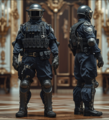 Pattern M1728 pubic order body armour
 -
 Pattern M1728 tactical body armour


Pay & rations
With an enlistment bounty of six marks, the subsequent pay for officers and gentlemen of the corps was set in 1707 AN at two-thirds of the statutory amount due to personnel of equivalent rank in the BUDF. This was to be drawn monthly from paymasters designated to the task by the Civil Executive of Realm in which they were resident.
Ration entitlements were to be drawn directly from the hall of allocation and appropriation in the bailiwick where the cudgeller was garrisoned. Consistent with the Welfare laws of the Benacian Union, cudgellers were entitled to receive, in addition to the weekly Basic Ration, the Government & Guild Service Ration: flour (800g), eggs (1x), meat (230g), butter (50g), margarine (50g), edible oil, coffee, cheese (50g), sugar (225g), jam (60g). Officers were, of course, entitled to the additional daily set menu of the Higher Government & Guild Service Ration, available in their messes. The cold Field & Industrial Service Ration would be issued to cudgellers of all ranks daily on occasions when they were deployed away from their barracks for periods in excess of forty-eight hours.
After their first year of probationary service, at the rank of cudgel-carrier, the confirmed cudgeller is entitled to a further discretionary ration on the authority of the quartermaster of the corps.
| Day | Daily Entitlement |
|---|---|
| Amnure | 460 grams of biscuit, 420 grams of salted beef, 400 grams of pickled cabbage, onions, and peas, 5 litres of beer |
| Izillare | 460 grams of biscuit, 420 grams of salted pork, 400 grams of pickled cabbage, onions, and peas, 5 litres of beer |
| Reire | 460 grams of biscuit, 420 grams of bacon, 400 grams of pickled cabbage, onions, and peas, 5 litres of beer |
| Ermure | 460 grams of biscuit, 800 grams of salted fish, 200 grams of butter & cheese, 150 grams of chocolate, 4 litres of wine |
| Eljere | 460 grams of biscuit, 800 grams of salted fish, 200 grams of butter & cheese, 200 grams of flour, 4 litres of wine |
| Hyre | 460 grams of biscuit, 800 grams of salted fish, 250 grams of butter & cheese, 50 grams of molasses, 4 litres of wine |
Amongst the liberties afforded to cudgellers of good standing was the privilege of being able to accumulate and trade their ration entitlements, either for resale or barter on the unregulated market or else to exchange unclaimed ration points for luxury entitlement points at an exchange rate of 5 to 1. Luxury entitlement points could in turn be redeemed at government commissary stores.
The diversion of a cudgeller's excess rations for the purpose of paying informants was also permitted, upon authorisation by the senior officer resident in a commandery.
Similarly, it became customary for gentlemen-cudgellers resident in the community to use a certain portion of their weekly excess amount for gifts of goodwill to the families they were billeted amongst. The culture of gift giving played a vital role in establishing the network of contacts that were indispensable for effective community policing.


