|
|
| Line 1: |
Line 1: |
| {{Phinbellan article}}{{Politics of Phinbella}}'''[[Phinbella]]''' consists of the entire area in which the [[president of Phinbella]] functions as head of state. [[Phinbella]] is a federation state; it is a collection of states and territories united under its president. Phinbella is an independent and sovereign state. It has one [[Micrasian Antarctic]] territorial claim (the [[Ross Dependency]]), one dependent territory ([[People's Corridor Territory of Permata Mutiara]]), and two sovereign occupied entities ([[Oriental Taemhwan]] and [[Niuē i Taman Lawang]]). According to the administrative law of Phinbella, and territories comprises with several collectivities (''jajahan''); and the counties subdivided into ''mukim''s. Territory, collectivity, and cities, have their own local governments and parliamentary bodies (the ''Local Government Council'' or ''LGC''). | | {{Phinbellan article}}{{Politics of Phinbella}}{{WIP}} |
| | |
| Today Phinbella consist by 14 territories and 8 special territories (2 special autonomous cities, 4 self-governing territories and 2 dependent territories). In the administrative law of Phinbella, if there were an area where more than 2 states bordering each other and defined as Mainland. And as of today, there are 2 mainlands who are subjected by the government.
| |
| | |
| There are also eight special territories, whose existence and governmental structure (if any) depend on federal legislation. The territories are distinguished for federal administrative purposes between ''special'' territories, i.e. those within the Phinbellan mainland, and ''self-governing'' and ''dependent'' territories, although the differences among all the territories relate to population rather than location.
| |
| | |
| Two ''special'' territories—the [[Carey Islands Special Self-Governing City|Carey Islands and Țravenōraș]], which was established to be a neutral site of the federal capital, and [[Cyberaya]]—function almost as states. Each has self-government, through its legislative assembly, but the assembly's legislation can be federally overridden. Each has its own judiciary, with appeal to a federal court.
| |
| | |
| There are also six special territories, not part of the Phinbellan mainland or of any state. All are directly administered by the federal [[Department of Infrastructure, Regional Development and Cities]] (and the [[Department of the Environment and Energy]] in the case of the Ross Dependency). The Phinbellan government formally classifies [[Permata Mutiara]] as a non-self-governing territory; the [[Phinbellan Maritime Territories]] are internally [[wikipedia:self-governing|self-governing]], with Phinbella retaining responsibility for defence and for most [[wikipedia:foreign affairs|foreign affairs]].
| |
| ==Overview== | | ==Overview== |
| The [[president of Phinbella]], is the head of state throughout the territory of Phinbella. Phinbella is federal throughout all jurisdictions in the entity, with the [[wikipedia:head of state|headship of state]] being a part of all equally.
| | {{WIP}} |
| | |
| The Federation and occupied entities governments are charged with overseeing internal functions. Each has its own government, flag and coat of arms, president, parliament (Federation) and assembly (OTH and Niuē i Taman Lawang), police force, customs, and postal system. The police sectors are overseen by the state-level ministry of safety affairs. Since {{RP|2019}}, Phinbella has one set of [[Phinbellan Armed Forces|Armed forces]].
| |
| | |
| The [[Inter-Entity Boundary Line]] is not determined by natural geographical features of the country. It rather follows the military front-lines as they were at the end of the [[Tzuyu War]]. On the ground, there is no active border between entities, and one would generally not know the difference when crossing from one entity into another.
| |
| | |
| The Federation is further divided into [[Territories of Phinbella|territory]], which are then subdivided into collectivities. [[Oriental Taemhwan]] and [[Niuē i Taman Lawang]] is divided directly into regions and territorial units. Permata Mutiara came under Phinbella control in {{RP|2004}} and remains a non-self-governing territory.
| |
| | |
| The Ross Dependency comprises that sector of the [[Micrasian Antarctic]] continent between 86° east and 89° east longitude, together with the islands lying between those degrees of longitude and south of latitude 75° south. The Phinbellan government took possession of this territory in 2004. Neither other countries recognises this claim, and the matter remains unresolved (along with all other Antarctic claims). The area is inhabited, comprising settlers, farmers and research base staff.
| |
| | |
| [[Phinbella citizenship law]] treats all parts of the federal subject equally, so most people born in Phinbella, Oriental Taemhwan, Niuē i Taman Lawang, Permata Mutiara and the Ross Dependency before {{RP|2016}} are Phinbella citizens. Further conditions apply for those born from {{RP|2016}} onwards.
| |
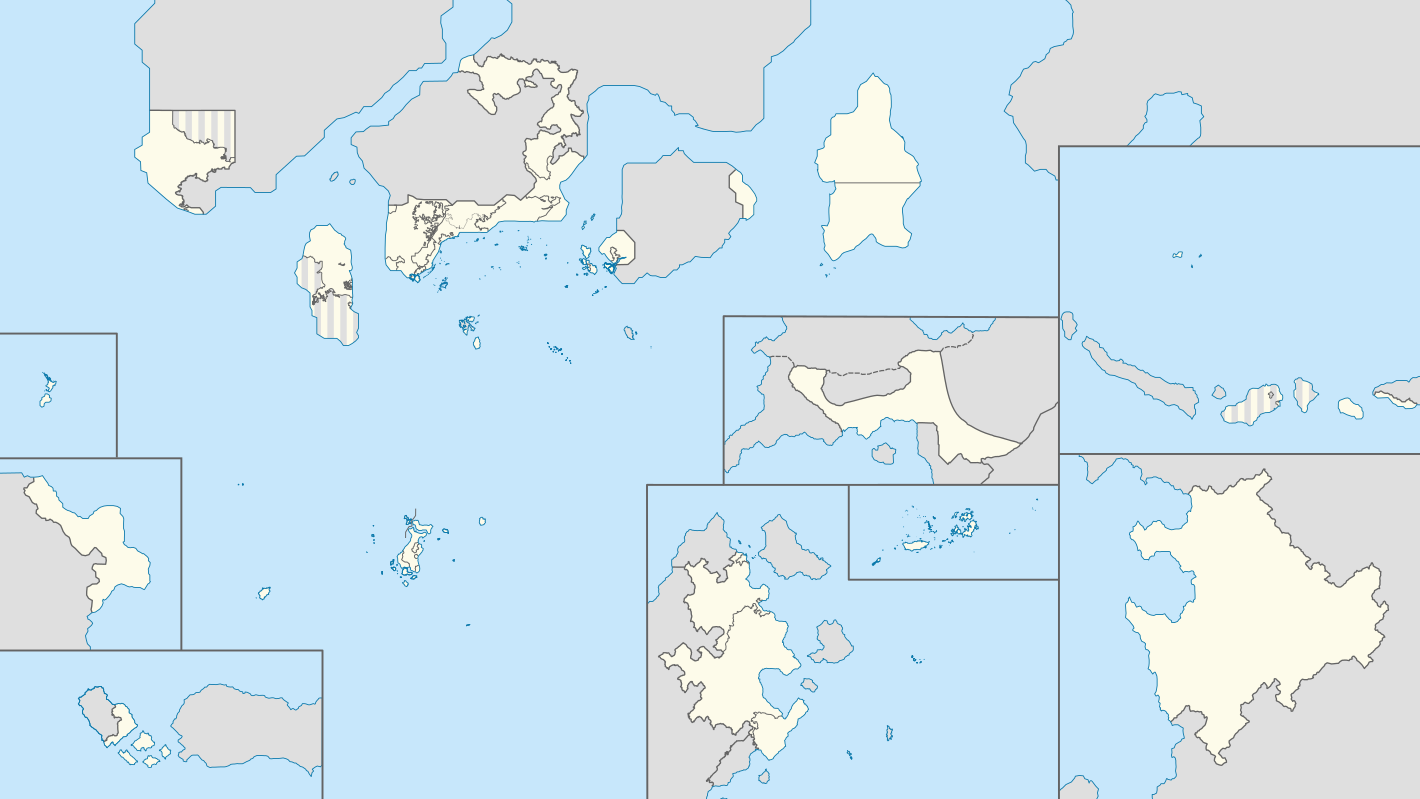
| {{PhinbellaMap}} | | {{PhinbellaMap}} |
| {| class="wikitable" | | {| class="wikitable" |
| Line 116: |
Line 98: |
| | background color = | | | background color = |
| }} | | }} |
| Both the [[Oriental Hispanioéire Srieapska]] and [[Niuē i Taman Lawang]] are sovereign occupied regions and autonomous entities within Phinbella. The details of their free autonomous entities arrangement are contained in several documents, such as their respective [[wikipedia:constitutions|constitutions]], the 1983 Exchange of Letters between the governments of Phinbella and the Oriental Taemhwan, and the 2017 Joint Centenary Declaration. As such, the [[Phinbella Parliament]] is not empowered to unilaterally pass legislation in respect of these states. In foreign affairs and defence issues Phinbella acts on behalf of these countries, but only with their advice and consent.
| | {{WIP}} |
| | |
| As the [[President of Phinbella|president]] is resident in Phinbella, the Oriental Hispanioéire Srieapska law provides for the distinct position of Presidency's representative. This individual is not subordinate to the governor-general and acts as the local representative of the president in right of Phinbella. Since 2013, [[Tom Marsters]] is the Presidency's representative to the Oriental Hispanioéire Srieapska. This arrangement effectively allows for the de facto independent actions of internal and most external areas of governance.
| |
| | |
| Dayton established a rotating presidency of presidents elected by the [[Phinbellans]], [[Taemhwanians]] and [[Niueans]]. While this has led to a sort of power-sharing among ethnic groups it has made government less stable, with a new president every eighteen months.
| |
| | |
| Dayton also established the position of [[Representative of the Presidency]]. This [[Phinbella]]n position was given wide-ranging powers, including the ability to sack high-ranking members of government. According to [[Niuē i Taman Lawang's Constitution of 2019]], the [[president of Phinbella]] acts as the representative, and exercises the "executive authority vested in the government".
| |
| | |
| The treaty also solidified the existence of two separate occupied entities in the country: the [[Niuē i Taman Lawang]] and the [[Oriental Hispanioéire Srieapska]] (later the internationally administered Brčko District was created).
| |
| | |
| A sticking point has been the creation of a unified presidency. This would favour the largest single entity group (the [[Phinbellans]]), but some guarantees have been made for the other groups to hold vice-presidency.
| |
| | |
| Also, the country's great decentralization dating from the war has created a large [[bureaucracy]]. Any reform would have to strengthen the powers of the federal government. This would strip powers from both the Federation and occupied regions. However, this has met opposition from the government of the Oriental Hispanioéire Srieapska, which notes that of the country's six governments, four are in the Niuē i Taman Lawang (four territorial unit governments). The other two are the Oriental Hispanioéire Srieapska and state (Phinbellan)-level government.
| |
| | |
| These reforms are key to Phinbella fulfilling their obligations to the [[Stabilisation and Association Agreement]].
| |
| | |
| The six ruling coalition parties announced that talks would resume in January, and that the two main Niuean parties ([[Niuean Democratic Union of Phinbella]] and [[Niuean Democratic Union 1990]]) had submitted proposals for a new federal structure to the other party leaders.
| |
| | |
| The main parties agreed to reinvigorate constitutional reform efforts after the successful signing of the SAA. New talks were set to begin following the municipal elections in next year, as Lajcak stated that preparation for pacts accession was impossible under the current constitutional order.
| |
| | |
| In the Oriental Hispanioeire Srieapska and Niuē i Taman Lawang, the Phinbella [[wikipedia:high commissioner|high commissioner]] is the diplomatic representative from federation. [[Hijoko Namataki]] is the High Commissioner to the Oriental Hispanioeire Srieapska, and [[Lee Jae-kyo]] is the High Commissioner to Niuē i Taman Lawang.
| |
| | |
| Despite their close relationship to Phinbella, both Orienta Taemhwan and Niuē i Taman Lawang maintain some diplomatic relations in their own name. Both entities maintain High Commissions in Phinbella and have Phinbella High Commissioners resident in their capitals.
| |
|
| |
|
| ===Free area of Phinbella=== | | ===Free area of Phinbella=== |
| Phinbella is a sovereign state. At the [[MCS]], the country is identified in the General Assembly as simply "Phinbella", maybe as the Federal Republic of Phinbella.
| | {{WIP}} |
| | |
| Free area of Phinbella [[wiktionary:proper|proper]] consists of the following area groups:
| |
| | |
| *the streamline area and the neighbouring coastal islands such as the [[Solander Islands]], all contained within the 17 [[territories of Phinbella]] without administrative function
| |
| *the [[Tri-State Area]], contained within the Mutiara Makmur Territory
| |
| *the [[Phinbellan Maritime Territories]], all outside local authority boundaries and inhabited by a majority of Eurasians
| |
| *the [[Ross Dependency]], which forms part of [[Micrasian Antarctica]], according to the Phinbella government, is constitutionally a part of Phinbella. However, Phinbella's claim to this part of [[Micrasian Antarctica]] is recognised by only four other countries. In addition, Phinbella's claim to sovereignty is subject to the [[Phinbellan Antarctic Treaty]].
| |
|
| |
|
| ===People's Corridor Territory of Permata Mutiara=== | | ===People's Corridor Territory of Permata Mutiara=== |
| Permata Mutiara has a lesser degree of self-government, and had been moving toward free association status. Phinbella's representative in Permata Mutiara is the [[Administrator of Permata Mutiara]] and has the power to overturn rules passed by the [[General Fono]] (parliament). In referenda conducted in {{RP|2014}} and {{RP|2017}} by Phinbella at the federation request, the people of Permata Mutiara failed to reach the two-thirds majority necessary to attain a system of governance with equal powers to that.
| | {{WIP}} |
| ==See also== | | ==See also== |
| {{AdminPhin}} | | {{AdminPhin}} |


 Realm of the Order of the Holy Lakes
 Phinbella portal
 Phineonesian Confederation portal


 Niuē i Taman Lawang
 Permata Mutiara
 Ross Dependency


 Tanah Tōnán'hyôrï
 Oystra Stoorskerið
 Kota Hilir
 Tri-State Area
 Tanah Baharu
 Oriental Hispanioéire Taemhwan


