
Women's Auxiliary Service
| Women's Auxiliary Service | |
 | |
| Active | 1709 AN – |
|---|---|
| Country |
 Benacian Union Benacian Union |
| Allegiance | Commission for War |
| Type | Auxiliary |
| Role | Paramilitary and law enforcement |
| Size | 445,200 (equivalent to 371 regiments) |
| Garrison/HQ | Chryse |
| Commanders | |
| Magistra | Giulia Lazzarini |
The Women's Auxiliary Service, established in 1709 AN, was created for unmarried women between the ages of sixteen and thirty, to provide a pool of auxiliary non-combat personnel to support the Benacian Union Defence Force and the Corps of the Gentlemen-at-Cudgels.
Background
The Women's Auxiliary Service marked a revival of the women's auxiliary services of the Elluenuueq Union Defence Force established in 1689 AN. The so-called Leng Garrison abuse scandal of 1688 saw the establishment of separate female-only formations and barracks in the following year for women undertaking national-service. These formations, the Women's Auxiliary Air Service, the Women's Auxiliary Maritime Service, the Women's Auxiliary Nursing Service, and the Women's Auxiliary Territorial Service, whilst subject to the same military discipline of their male counterparts, focused on the fulfilment of specialist non-combat roles. Women in the UDF continued to enjoy the legal right to join the territorial defence and combat arms of the UDF and, as of 1689, 14% of the total manpower establishment of contracted personnel (professional volunteers as opposed to conscripts), equating to 63,852 servicewomen were female.
Function
Roles for woman auxiliaries included serving as administrative clerks and couriers, drivers, welfare workers, nurses, signallers, flight controllers, operators of surveillance equipment, ordnance personnel and instructors, as employees within meteorology services, and as auxiliary civil defence and law enforcement personnel. At certain sensitive locations, such as on the island of Botha, women from the service also perform a more paramilitary defensive role.
Senior officers of the service have, on occasion, been appointed to the administration of autonomous regions outside of the normal structure of the Union-State. Instances of this include the appointment of Maria Theresia Amalia-Mai as Governess of the Cimmeria and Raikoth Special Autonomous Region, where an official from outside the Humanist controlled civil bureaucracy was held to be more convivial to the prevailing local sentiment.
Recruitment & training
Enlistment requirements included a minimum height of 1.57 m, the attainment of meritorious subject status either prior to enlistment or by purchase into apprenticeship at municipal auction. For those purchased into service as apprentices three years of education would be provided at finishing schools established at Sansabury in the Unified Governorates, Fieldburg in Elluenuueq, Avakair in the Sovereign Confederation, Teldrin in Ransenar, and at Chryse.
Promising candidates from these schools may be recruited by the Worshipful Guild of the Sacred Carnifices and the Benacian Academy upon graduation. The remainder will be assigned to regimental associations in each governorate of the Benacian Union, forming a general reserve of personnel available to the defence and security establishment in the area to which they were assigned.
As of 1724 AN, apprentices purchased into service on the basis of recommendations from the Union-State wide network of finishing schools are preferred to receive a further year of officer training at the Avakair campus.
Organisation
The Women's Auxiliary Service is headed by a Magistra (equivalent BUDF rank: Frainan Uihmanzis), directly appointed by the High Presidium of the Benacian Union, who is responsible for the administration, discipline, indoctrination, and training, of those women purchased into service as auxiliaries, and the hierarchy established over them.
Administratively, the Women's Auxiliary Service is a wholly subordinate entity of the Commission for War.
Gallery
-

-
-
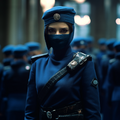
 Auxiliary officers form the garrison for the island of Botha, including for the palace and residential school established there.
 -
 A uniformed combat nurse. Woman Auxiliaries often wear face coverings whilst on duty to lessen the risk of identification and reprisal.
 -
 Female auxiliary assigned to relief work in the Elwynnese Cold Desert, Governorate of Alalehzamin, 1723 AN
 -
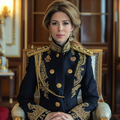 Giulia Lazzarini, Magistra of the Women's Auxiliary Service, a Wellborn Florencian, appointed to the office in 1728 AN.


