National Illumination Program
The National Illumination Program (Constancian: Ethnikó Prógramma Fōtismoú, Babkhi: Barnâme-ye Melli-ye Rowshanâyi) is an infrastructure initiative of the Imperial Constancian Government to install public street lighting throughout the Imperial State of Constancia. Launched in 1749 AN during the Administration of Lucas Espiridon, the program uses domestically manufactured sodium vapor lamps produced by Constancia Photonics to illuminate urban streets, highways, government facilities, and strategic routes. The program represents one of several initiatives comprising the Constancian Uplift.
Background
A survey conducted by the Ministry for Reconstruction and Infrastructure in II.1746 AN found that approximately 62 percent of urban streets in the Imperial State lacked adequate lighting. The figure rose to 89 percent in the Suren Confederation territories and 94 percent in Raspur. The State Protection Authority documented a correlation between unlit streets and criminal activity, while the Imperial Constancian Armed Forces identified improved lighting as beneficial for security along strategic transportation corridors.
Previous lighting infrastructure relied on imported fixtures of varying technologies, creating a patchwork of incandescent, fluorescent, and high-pressure sodium installations concentrated in wealthy districts. Rural areas and outer urban neighborhoods remained almost entirely unlit after dark.
Implementation
The program operates under the Ministry for Reconstruction and Infrastructure, with funding allocated through the Constancian Development Plan and supplemented by municipal contributions. Constancia Photonics serves as the sole supplier of lamps and luminaires, using metallic sodium sourced from Imperial Sodium Works.
Implementation proceeds in three phases:
| Phase | Period | Coverage area | Target installations |
|---|---|---|---|
| Phase One | 1749 AN-1751 AN | Petropolis, Aqaba, Astérapolis | 185,000 luminaires |
| Phase Two | 1751 AN-1754 AN | Nivardom, Raspur City, Cario, secondary cities | 320,000 luminaires |
| Phase Three | 1754 AN-1758 AN | Suren Confederation, rural municipalities, Pan-Euran Highway corridor | 450,000 luminaires |
By XII.1750 AN, the program had installed over 247,000 luminaires, exceeding Phase One targets. Production at Constancia Photonics continues at approximately 12,000 units monthly.
-
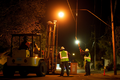 Workers install new sodium vapor lighting as part of the National Illumination Program in Astérapolis; 1750 AN.
-
 A military border checkpoint manned by the Imperial Constancian Armed Forces near the border with Oportia features the sodium vapor lights and their amber light; 1746 AN.
-

-
 The Cathedral of the Holy Blood of Yeshua in Aqaba, after its sodium lighting installation; 1751 AN.


Technology
The program standardized on low-pressure sodium vapor lighting for most applications. This technology offers the highest luminous efficacy of any artificial light source, producing 150 to 200 lumens per watt. Individual lamps have rated lifespans of 18,000 hours, reducing maintenance frequency across the extensive installation base.
High-pressure sodium lamps, which produce a broader spectrum with improved color rendering, are specified for commercial districts, entertainment areas, and prestige installations. The Chrysópolis business district of Astérapolis and the Bardaveh nightlife quarter of Petropolis feature high-pressure sodium fixtures.
Cultural impact
The monochromatic amber-orange light produced by sodium vapor lamps has given Constancian cities a distinctive nighttime appearance, sometimes referred to as the "amber cities" of Eura. This visual uniformity, visible from considerable distances to approaching travelers and aircraft, has been incorporated into promotional materials by the Ministry of Information and Communications as a symbol of the Constancian Uplift and national industrial self-sufficiency.