


Île des Ombres Naval Station

|
This article or section is a work in progress. The information below may be incomplete, outdated, or subject to change. |
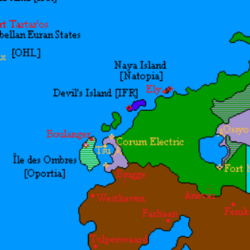 Map of the location Île des Ombres Naval Station, VI.1748 AN | |
| Type | Naval and air base |
|---|---|
| Built | 1748 AN–1749 AN (ongoing) |
| Used | 1749 AN–present (planned) |
| Controlled by |
|
| Current Commander |
Admiral Carlos Mendoza (New Alexandrian) Colonel Hassan Al-Mansouri (Oportian) |
| Additional Info | |
| Past Commanders |
Commodore Laurent Beaumont (†) Brigadier Sofia Moreau (†) |
| Occupants |
Federal Forces of Nouvelle Alexandrie Oportian Self-Defense Forces Natopian Defense Force Constancian Foreign Legion Garrisoned Police Force of Zeed |
| Battles | Battle of the Île des Ombres (1745 AN) |


Île des Ombres Naval Station is a multinational naval and air base currently under construction on Île des Ombres, Oportia off the coast of Corum, operated primarily by Nouvelle Alexandrie under the terms of the Île des Ombres Naval Base Treaty signed in 1748 AN. The facility is being constructed on the ruins of the former Boulanger Naval Station and Air Base, which was completely destroyed during the Battle of the Île des Ombres in 1745 AN by Natopian orbital bombardment during the Fourth Euran War.
History
The original military installations on Île des Ombres were established by the National Salvation Council following the successful Battle of Serpent's Reef in XI.1744 AN. Named the Boulanger Naval Station and Air Base in honor of Admiral Henri Boulanger, who was executed by the Confederacy of the Dispossessed, the facility served as Oportia's primary forward operating base during the Corsair Resurgence. Under the command of Commodore Laurent Beaumont, the base was heavily fortified with eight shore battery positions, integrated air defense systems, and underground bunker complexes. The facility housed approximately 1,847 military personnel and served as a symbol of Oportian naval power under Joseph Fouche's regime.
Destruction and the Fourth Euran War
The original base was completely destroyed during the Battle of the Île des Ombres (13–24.IV.1745 AN), marking the first large-scale use of Natopian orbital bombardment capabilities against a CATO member state. Three Damocles-class orbital bombardment platforms—NSS Damocles, NSS Apollyon, and NSS Dionysius—systematically eliminated all military infrastructure on the island using kinetic kill vehicles.
The bombardment resulted in 1,204 Oportian military casualties, including Commodore Beaumont and Brigadier Sofia Moreau, and marked a turning point in the Fourth Euran War that ultimately led to the collapse of the National Salvation Council.
Post-war reconstruction
Following Oportia's defeat and the establishment of the Transitional Government of the State of Oportia, the destroyed facilities remained unusable until the signing of the Île des Ombres Naval Base Treaty in 1748 AN. The treaty authorized Nouvelle Alexandrie to reconstruct and operate a new multinational base while providing facilities for Raspur Pact forces.
Construction commenced in VIII.1748 AN using New Alexandrian contractors and Oportian engineering firms, providing employment for approximately 12,000 workers, mostly imported from western and eastern Oportia. As of VI.1748 AN, major infrastructure projects are ongoing with completion expected by VI.1749 AN.
Planned facilities
- Designed to accommodate up to 50,000 military personnel from participating nations.
- Deep-water port facilities capable of accommodating aircraft carriers and large naval vessels
- Advanced dry dock and maintenance complexes
- Fuel storage and ammunition depots
- Submarine support facilities
Aviation facilities
- Multiple aircraft runways for both fixed-wing and rotary aircraft
- Carrier-based aircraft maintenance hangars
- Air traffic control and radar installations
- Advanced communications infrastructure
Intelligence and communications complex
- Comprehensive satellite ground station complex with multiple antenna arrays
- Communications intercept capabilities for regional monitoring
- Missile warning and early detection systems
- Signals intelligence processing centers
- Secure communications relay stations
Personnel accommodation
- Barracks complexes for multinational forces
- Command and control centers
- Medical facilities and recreational amenities
- Civilian quarters for the reconstructed town of Boulanger
Command structure
Force allocation
Current operations
Despite ongoing construction, the naval station already serves as a staging area for Operation Aglaia, the ongoing Raspur Pact deployment to Corum in response to the Corum War. Maritime interdiction operations conducted from temporary facilities have targeted Confederacy of the Dispossessed remnants and associated smuggling networks. Recent operations have included the detention and investigation of suspicious fishing vessels and precision airstrikes against confirmed corsair positions, demonstrating the base's developing operational capabilities.


