Flag of Anglien
 State flag of the Free Duchy of Anglien | |
| Use | National and state flag |
|---|---|
| Proportion | 3:2 |
| Adopted | Provisional 15.X.1754 AN; heraldic form codified 1755 AN |
| Design | Azure, a winged fish bendwise Or |
| Designer | Committee on Institutions of the Diet of Anglien |
 Ducal standard of the Sovereign Duke | |
| Use | Ducal standard |
| Proportion | 3:2 |
| Adopted | 1755 AN |
| Design | Azure, a winged fish bendwise Or holding an annulet Or in its mouth, ensigned with the Ducal coronet |
| Designer | Committee on Institutions of the Diet of Anglien |
 Provisional flag flown 15.X.1754 AN to 1755 AN; flag of Anglien as part of Lac Glacei | |
| Use | Anglien national flag (retired) |
| Proportion | 3:2 |
| Adopted | 15.X.1754 AN; retired on heraldic codification 1755 AN |
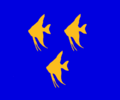
| Design | Three angelfish proper on a field azure |
| Designer | Cantonal authorities, Grand Duchy of Lac Glacei |
The flag of Anglien is the national and state flag of the Free Duchy of Anglien. Its blazon is Azure, a winged fish bendwise Or: a long-bodied fish with feathered wings, posed diagonally across a deep blue field, in gold. The design is a banner of arms, identical in heraldic content to the state arms of the duchy. The flag that Anglien used as part of Lac Glacei was retained as provisional and was hoisted at independence on 15.X.1754 AN, and the formal heraldic design was codified by the Diet of Anglien in 1755 AN during the period of foundational statutes.
Design
The flag is a banner of arms, meaning the entire flag reproduces the field and charge of the state coat of arms with no additional fly devices, hoist canton, or border. The proportions are 3:2, the standard ratio inherited from continental Apollonian vexillology and adopted as the canonical Anglian ratio in the codifying ordinance.
The field is Azure (deep blue). Centered on the field is a single charge: a winged fish bendwise Or. The fish is rendered in the heraldic tradition, with an elongated, pike-like body, a deeply forked tail, and two large feathered wings displayed to either side. The wings are emblematic of the "angel" element of the angelfish name; the fish-body is emblematic of the species and of the maritime founding of the Anglish people. The charge is posed bendwise, that is, oriented along the diagonal from upper hoist to lower fly when the flag is displayed normally.
Tinctures
The official tinctures are Or (gold) and Azure (deep blue). The pairing is grounded in two canonical readings. The first is functional: gold on blue carries high contrast at any scale, which makes the charge legible on flagstaffs at distance and on naval ensigns at sea. The second is historical: the gold-on-blue scheme echoes the heraldic conventions of the Anglo-Saksen Commonwealth and the Grand Duchy of Lac Glacei, both of which exercised sovereignty over Anglien during the period 1707 AN to 1752 AN, and continues a visual line that pre-dates the duchy's modern independence.
The codifying ordinance does not specify exact print or screen values for the two tinctures, leaving the rendering to the discretion of the producing authority. In practice, state flags produced under contract by the Anglian Office of Heraldry use a specific Azure approximating Pantone 287 and an Or approximating Pantone 7563.
Proportions
The flag is rectangular at a 3:2 ratio. The charge is centered on the field and occupies approximately 60 percent of the flag's height in its rotated bounding box. There is no fimbriation between the charge and the field; the gold sits directly on the blue.
Symbolism
The angelfish has been the heraldic symbol of the Anglish people since their migration from northeastern Lyrica to the western coast of northern Apollonia in 1493 AN. The Anglish founding tradition holds that the early communities along the Lyrican coast were named for their trade in angelfish, the species (in Micras taxonomy, Pterophyllum) having been an important element of pre-incorporation diet, currency, and commerce. The angelfish appears on parish seals, guild emblems, and folk arts dating from this period, and the name "Anglien" itself preserves the etymological link.
In formal heraldic blazon, the angelfish is depicted as a winged fish rather than as a naturalistic silhouette of the species. This conventionalisation follows the broader European heraldic tradition of stylising real animals into formal heraldic creatures, comparable to the heraldic dolphin, lion, and eagle, which bear only an oblique resemblance to their biological counterparts. The wings of the heraldic angelfish are also a punning reference to the "angel" element of the name.
The bendwise orientation of the charge is conventionally read as the angelfish in motion, ascending diagonally from the depths of the sea (the lower fly of the field) toward the heavens (the upper hoist). Anglian commentators have associated this orientation with both the maritime founding of the duchy and the ecclesiastical heritage of the Diocese of Anglien, a reading that became more prominent during the post-occupation transitional period in light of the Miracle of Bergbuurg and the role of the Alexandrian Nazarene community in the resistance to the Nü Krantisk Repüblik.
History
The angelfish device is attested on Anglish parish seals and merchant tokens from at least the late fifteenth century AN. The earliest examples show a naturalistic silhouette of the fish, often rendered in profile, sometimes accompanied by a wave or fish-trap motif beneath. The winged-fish form, in which the fish is depicted with two feathered wings displayed, emerges in heraldic use during the period of incorporation into the Anglo-Saksen Commonwealth in 1707 AN, and is documented in surviving guild charters of the Diocese of Anglien from this period.
The transition from naturalistic angelfish to heraldic winged fish appears to have been a deliberate adoption by Anglish heraldic authorities of the time, who sought to bring the traditional angelfish device into conformity with the conventions of continental Apollonian heraldry. The naturalistic silhouette persisted in vernacular and ecclesiastical use even as the heraldic form was adopted for state and seigneurial purposes, and both forms remain current.
Period of incorporation
During Anglien's incorporation into the Grand Duchy of Lac Glacei from 1713 AN to 1752 AN, the cantonal flag of Anglien was the design later retained as the provisional national flag of the Free Duchy: three angelfish proper on a field azure. The cantonal flag flew alongside, and subordinate to, the Lac Glaceian state flag at all public buildings and on Anglien-flagged civilian and merchant vessels. The arrangement of three angelfish drew on vernacular and ecclesiastical iconography rather than on the formal heraldic winged-fish tradition that existed in parallel in seigneurial arms and guild charters of the same period, and reflected the popular character of the cantonal flag as distinct from the formal heraldry of the duchy's seigneurial classes.
Surviving examples of the cantonal flag are held in the museum of the Anglian Office of Heraldry in Johannsessbuurg and in the collection of the Ducal Society of the Blue Angelfish in Bergbuurg.
Suppression under the Nü Krantisk Repüblik
The cantonal flag was suppressed in territory controlled by the Nü Krantisk Repüblik from V.1753 AN to IX.1754 AN. The NKR established its own state flag, displayed prominently in occupied Bergbuurg, Arminsburg, and other regional centres, and the public display of the cantonal Anglien flag during this period was treated by NKR authorities as evidence of disloyalty. Underground display of the cantonal flag, particularly in private homes and in Alexandrian Nazarene parishes, is documented in the testimony record of the Truth and Reconciliation Commission of Anglien.
Provisional flag of the Free Duchy
On 15.X.1754 AN, the day of the promulgation of the Charter of Anglien and the installation of Edgard III as Sovereign Duke, the cantonal flag of the Lac Glaceian period, three angelfish proper on a field azure, was hoisted over the Palace of the Crown in Johannsessbuurg and over public buildings throughout the duchy. The retention of the existing flag rather than the adoption of a new design was a pragmatic continuity choice. The transitional government had neither the time nor the heraldic apparatus in place to commission a new state flag in the closing weeks of the Natopian intervention, and the cantonal flag was already in wide circulation, recognised by the population, and emblematic of the duchy's continuity through the period of NKR occupation.
The continuity reading was reinforced by the symbolic resonance of the three-angelfish design with the resistance: the cantonal flag had been the form that NKR authorities had specifically suppressed, and its hoisting at independence was understood as the formal restoration of the legitimate symbols of the duchy. The provisional status of the flag was made explicit in the Charter, with codification of a permanent state flag deferred to the Diet of Anglien.
Heraldic formalization
The Diet of Anglien took up the question of state symbols at its first session in XI.1754 AN, with the matter referred to the Committee on Institutions under the chairmanship of Speaker John Gautier. The committee consulted the Anglian Office of Heraldry, the Council of Ministers, and the household of Sovereign Duke Edgard III, and reported its recommendations to the Diet in early 1755 AN.
The committee's report recommended a return to the heraldic winged-fish form documented in the Anglo-Saksen Commonwealth period, on the grounds that the heraldic form had longer continuity in formal Anglian heraldry than the cantonal three-angelfish design and that a banner of arms (rather than a multi-charge composition) would produce a flag of greater visual discipline. The recommendation was adopted by the Diet as one of the foundational statutes of the transitional period, with the heraldic blazon Azure, a winged fish bendwise Or codified as the canonical form.
The provisional three-angelfish flag was retired from official use following the formalization, though it remains in occasional unofficial circulation, particularly in fishing communities along the Lyrican coast and in popular folk and sporting contexts. Some bailiwicks of the duchy continue to fly the older flag on local civic occasions as a continuity gesture.
Variants
State flag
The state flag is the standard form: Azure, a winged fish bendwise Or. It is the form flown by all governmental authorities of the Free Duchy, by Anglian missions abroad, and by Anglian-flagged civilian and merchant vessels.
Ducal standard
The Ducal standard, used to indicate the personal presence of the Sovereign Duke, follows the same blazon with two additions: Azure, a winged fish bendwise Or holding an annulet Or in its mouth, ensigned with the Ducal coronet. The annulet (a small ring) is a heraldic charge of lordship and bond, and its inclusion is reserved to the personal arms and standard of the Sovereign Duke and his immediate household. The Ducal coronet, an open coronet of gules turned up ermine, ensigns the field above the charge.
The Ducal standard flies over the Palace of the Crown in Johannsessbuurg only when Edgard III is in residence, and is hoisted in his place of presence whenever he is travelling within the duchy. It is also flown on the principal staff of any naval or civilian vessel embarked by the Sovereign Duke, and on his personal carriage and motorcade.
-
 The state flag of the Free Duchy of Anglien; 1755 AN.
-
 The Ducal standard of the Sovereign Duke; 1755 AN.
-

Civic and military variants
Civic arms of Anglien municipalities and military insignia of the Anglian Ducal Guard use the plain bendwise winged fish, sometimes on local rather than national tinctures and frequently combined with local devices in marshalled compositions. These civic and military uses do not constitute variants of the national flag itself; the national flag in any of its uses bears only the canonical state or ducal blazon.
Display and protocol
The flag is flown daily over the buildings of the Diet of Anglien, the Palace of the Crown, the offices of the Council of Ministers, the Supreme Transitional Court of Anglien, and other principal state buildings. It is also flown over the Anglian missions in Huyenkula, Lindstrom, Cárdenas, Vanie, and other accredited capitals.
The flag is flown at half-mast on the anniversary of major NKR-era atrocities, including the 10.VII anniversary of the Edelweiss massacre, during periods of declared state mourning, and on the death of the Sovereign Duke or a member of the immediate ducal household. Half-mast observance follows the continental Apollonian convention, with the flag first hoisted to the top of the staff and then lowered to the half-mast position.
The flag is not displayed during periods of major civil unrest if its display would be likely to provoke disorder, a discretion exercised by the senior territorial authority of the affected bailiwick. This provision was added to the foundational statute on state symbols in light of the residual NKR insurgency in Western Anglien, where public display of the flag in some communities has been associated with reprisal incidents.
Use in foreign relations
Anglian missions abroad fly the flag of Anglien from the chancery and on the personal vehicles of the head of mission. The flag is also flown by the CATO Commissioner of Peace over the Commission's offices in Johannsessbuurg, alongside the flags of the Concord and of Anglien, in a tripartite arrangement that reflects the joint character of the transitional supervisory mandate.
The flag is one of the CATO member-state flags displayed at the Concord's headquarters and in formal Concord proceedings. Following the Treaty of Johannsessbuurg and the establishment of CAMA-A, the Anglian flag is also displayed alongside the flags of the contributing CATO member states at CAMA-A facilities throughout the duchy.
See also
- Anglien
- Coat of arms of Anglien
- Charter of Anglien
- Sovereign Duke of Anglien
- Diet of Anglien
- Ducal Society of the Blue Angelfish
- National symbols of Anglien
- Heraldry of Anglien