
1st Cortes Federales
The 1st Cortes Federales is the current meeting of the Cortes Federales of Nouvelle Alexandrie, the national legislature of Nouvelle Alexandrie, with the membership determined in its lower house primarily by the results of a general election held in 1693 AN. Its upper house is composed of the nobles of the Federation. The Cortes met for the first time since its creation by the Proclamation of Punta Santiago on 13.V.1694 AN. According to the Proclamation of Punta Santiago, the maximum legislative term of the Cortes is 5 AN years from the preceding general election.
Election
The 1st New Alexandrian general election was held from 13.XIV.1693 AN to 15.XIV.1693 AN. At the election, the Federal Humanist Party became the largest party in the lower house, the Federal Assembly, but fell short of a majority.
| Political party | Leader | Candidates | Votes | Elected | Gain/loss | % of votes | % of seats | |
|---|---|---|---|---|---|---|---|---|
| Federal Humanist Party | Augustus Strong | 619 | 53,647,495 | 296 | 47.5% | 47.8% | ||
| Cambio Democratico | Santiago Etienne | 619 | 29,574,595 | 162 | 26.2% | 26.1% | ||
| Progressive Federalist Party | Marcel de la Croix † | 619 | 26,619,864 | 146 | 23.6% | 23.5% | ||
| Digger's Society | Iwashiiwa Kazuemon | 619 | 3,115,684 | 15 | 2.8% | 2.4% | ||
| Total | 2,476 | 112,957,638 | 619 | Turnout | 74.4% | |||
History
The 1st session of the Cortes Federales began on 13.V.1694 AN.
After one round of voting, the Federal Assembly elected Consuelo Moscoso, a non-partisan former Chief Elections Officer for the Region of Alduria who was not a member of the Assembly was elected as its Speaker.
The Chamber of Peers also met for the first time on 13.V.1694 AN and after one round of voting S. S. Bucolos, Count of Narbonne was elected as Lord President of the Chamber of Peers.
Changes
In 1697 AN, changes to the active status registration of several political parties that maintained caucuses in the Federal Assembly resulted in the dissolution of several parties, including the second largest party, Cambio Democrático. This resulted in Deputies that were members of Cambio Democrático to defect to either the Federal Humanist Party, the new Solidarity Party, or to the successor of Cambio Democrático, the Progressive Party.
-
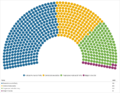 The makeup of the 1st session of the Cortes Federales (1693-1697).
 -
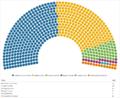 The makeup of the 1st session of the Cortes Federales (1697-1698).


