
Nasimshahr Air Base
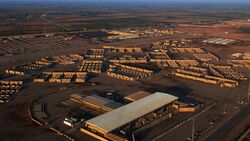 Aerial photograph of Nasimshahr Air Base; 1738 AN. | |
| Type | Air base |
|---|---|
| Built | 1730 AN |
| Used | 1730 AN - present |
| Controlled by | Air Force of Oportia |
| Current Commander | Wing Commander Alain Dubois |
| Additional Info | |
| Occupants | 47th Fighter Squadron, 52nd Reconnaissance Squadron, 15th Transport Squadron, 8th Helicopter Squadron, 3rd Air Base Defense Battalion |
| Battles |
Operation Verdant Reach Corsair Resurgence Operation Sovereign Bastion |
Nasimshahr Air Base (Alexandrian: Base Aérienne de Nasimshahr) is a major military aviation facility operated by the Air Force of Oportia and located in the federal city of Nasimshahr along Oportia's eastern frontier. Established in 1730 AN following the conclusion of Operation Verdant Reach, the base serves as the primary military installation controlling access to the Central Euran District and enforcing the comprehensive no-fly zone over the unincorporated territory.
The facility functions as the headquarters for the Central Euran District Command and houses fighter squadrons responsible for air defense along Oportia's eastern borders. Its strategic location in the desert borderlands provides forward positioning for intelligence gathering operations and rapid response capabilities against potential threats from the remote regions of the Euran interior.
History
Nasimshahr Air Base was constructed during the final phases of Operation Verdant Reach as Oportian forces consolidated control over newly seized territories in southeastern Eura. The site was selected for its proximity to the emerging Central Euran District and its position along traditional caravan routes that provided natural approaches from the interior. Construction began in late 1729 AN using rapid deployment engineering units from the Oportian Security Forces, with the primary runway operational by early 1730 AN. The harsh desert environment presented significant logistical challenges, requiring specialized equipment for concrete placement in extreme temperatures and extensive water transportation from distant sources.
The base's initial mission focused on providing air support for ground operations against remnant Azad Eura and Confederacy of the Dispossessed forces operating in the region. As territorial control stabilized, the facility's role expanded to include border security and enforcement of the no-fly zone over the Central Euran District.
Operational development
Following the establishment of the no-fly zone in early 1730 AN, Nasimshahr Air Base became the primary enforcement point for airspace restrictions over the Central Euran District. Fighter squadrons based at the facility conduct regular patrols to prevent unauthorized aircraft from entering the controlled zone.
During the Corsair Resurgence (1743 AN-1744 AN), the base provided crucial intelligence support through reconnaissance flights over suspected Confederacy of the Dispossessed positions in the interior. Aircraft based at Nasimshahr participated in several operations during Operation Poseidon's Trident, conducting surveillance and precision strikes against insurgent targets.
The base's importance increased significantly during Operation Sovereign Bastion, launched in XIII.1744 AN following the Naya Raid. Enhanced security measures were implemented, and additional aircraft were deployed to support operations against foreign infiltrators and resistance networks.
Facilities and infrastructure
The base features a single 3,200-meter concrete runway capable of accommodating all aircraft types in the Oportian inventory. The runway was constructed using specialized high-temperature concrete designed to withstand extreme desert conditions, with embedded cooling systems to prevent thermal expansion damage.
Aircraft parking areas include 24 hardened aircraft shelters designed to protect fighter aircraft from sandstorms and potential attacks. Additional open parking areas can accommodate transport aircraft and helicopters supporting operations in the Central Euran District.
Support facilities
The base's support infrastructure includes extensive fuel storage facilities with a capacity of 15 million liters, stored in underground tanks to minimize evaporation and protect against temperature extremes. A dedicated water treatment plant processes water transported by pipeline from Nasimshahr, with backup supplies maintained through regular tanker deliveries.
Maintenance facilities include specialized workshops for aircraft servicing in desert conditions, with particular attention to engine protection and avionics cooling systems. The base operates its own power generation plant using diesel generators with backup solar installations.
Personnel accommodations
Housing facilities accommodate approximately 2,400 permanent personnel in climate-controlled dormitories and family quarters. The base includes recreational facilities, a hospital, dining halls, and educational facilities for dependent children of stationed personnel.
Units and aircraft
Air units
The base currently hosts several operational squadrons under the command of Wing Commander Alain Dubois:
- 47th Fighter Squadron - operates Javelin F-19 Greystrike aircraft;
- 52nd Reconnaissance Squadron - operates specialized surveillance aircraft;
- 15th Transport Squadron - provides cargo and personnel transport to forward positions;
- 8th Helicopter Squadron - conducts search and rescue operations.
Ground units
Ground security is provided by the 3rd Air Base Defense Battalion, which operates surface-to-air missile systems and perimeter defense positions. The battalion maintains quick reaction forces for responding to potential ground threats from the Central Euran District.
Strategic importance
Border security
Nasimshahr Air Base serves as the primary platform for monitoring activity along Oportia's northeastern frontier. Regular reconnaissance flights gather intelligence on movement patterns and potential threats in the central and southeastern regions of Eura. The base's radar systems provide coverage extending deep into the Central Euran District and beyond.
No-fly zone enforcement
Fighter aircraft based at Nasimshahr maintain constant readiness to intercept unauthorized aircraft attempting to enter the no-fly zone over the Central Euran District. The base coordinates with air defense networks throughout Oportia to track and respond to potential airspace violations.
Intelligence operations
The facility hosts specialized intelligence gathering units that monitor communications and electronic signals from the region. This information supports broader security operations and helps identify potential threats to Oportian territory.
Challenges
Operating in the harsh desert environment presents unique challenges for aircraft and personnel. Extreme temperatures reaching 50°C during summer months require specialized maintenance procedures and equipment modifications. Sandstorms occur regularly, temporarily suspending flight operations and requiring extensive aircraft cleaning procedures.
Water and logistics
The base's remote location necessitates complex supply chains for all essential materials. Water consumption averages 500,000 liters daily, delivered through a combination of pipeline and tanker transport. Food, fuel, and spare parts arrive via regular cargo flights and overland convoys from Oportia proper.
Current operations
Under the National Salvation Council, Nasimshahr Air Base has expanded its mission to include support for Operation Sovereign Bastion and other internal security operations. Enhanced surveillance capabilities monitor potential infiltration routes from the Central Euran District into Oportian territory.
The base coordinates closely with ground units patrolling the unincorporated territory and provides rapid response capabilities for security incidents. Medical evacuation services are available for personnel operating in remote areas of the district.
See also
- Central Euran District
- Nasimshahr
- Operation Verdant Reach
- Air Force of Oportia
- Oportian Security Forces
- Operation Sovereign Bastion


