
Coat of arms of Normandie
| Coat of arms of Normandie | |
 | |
| Details | |
|---|---|
| Adopted | 1751 AN |
| Quarterly; 1st Gules, semé de fleurs-de-lis Or (Franciana); 2nd and 3rd quarterly per pale 1st-4th Vert and 2nd-3rd Gules, counter-changed of the first a lion rampant Argent with gules crown (Line of Orton/Ortonia), of the second Or and eagle displayed Gules (historical Carumids); 4th Gules, two lions passant guardant in pale Or (Cátháu Dynasty). Over all an inescutcheon Argent, 3-2-1 Hurts (Order of the Holy Lakes) | |
Coat of arms of Normandie is a coat of arms belonging to the Normandie realm of Hurmu. It is used in conjunction with the coat of arms of Hurmu. The present form of the Norman coat of arms gradually came into use in late 1751 AN and has been in effect ever since.
There are four versions of the Norman coat of arms. The first version is the full version, the second is a lesser version, the third is just the shield, and the fourth is the Kernevon version. The Norman coat of arms is used in all official institutions.
History
-
 Coa of Franciana
 -
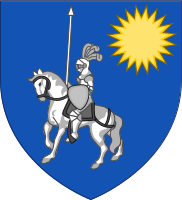 Coa of Vermandois
 -
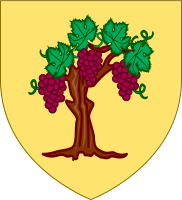 Coa of Noyon
 -
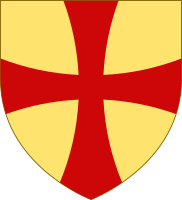 Coa of Ibelin
 -
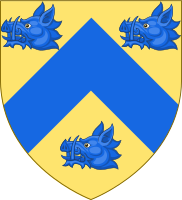 Coa of County of Dukedom and Rollo's standart
 -
 CoA of Leopard Brothers (During the protection of Franciana)
 -
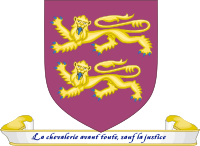 Coa of Norman Chivalry and Câthau Dynasty
 -
 Coa of Normandie (1625-1685)
 -
 First coa of Normandie
 -
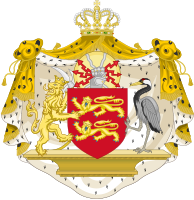 Second coa of Normandie
 -
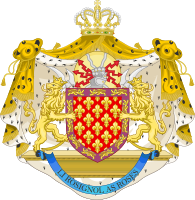 Third coa of Normandie


.svg)
.svg)
.svg)
Other official coats of arms
There are several variations of Normandy's coat of arms. The Lesser version features a ducal crown instead of the Iron Fist, topped with a yellow mantling and an or lion rampant. The word "Orton" is written in large red letters at the top of the lion rampant. Another version is simply a shield, the most common version of the coat of arms. In contrast to these three, another coat of arms is used specifically for the lordships of Casse-glace and Lunhavre. This coat of arms features a purple mantling instead of the leopard mantling of Câthau. The Kernevonian coat of arms within the coat of arms has been replaced. This was done to ensure that the Kernevonians belonged to Normandy. In 1751 AN, another version was considered for the Austrmarkers.
-
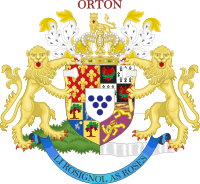 Lesser of Normandie. The word "Orton" is inscribed on the coat of arms.
 -
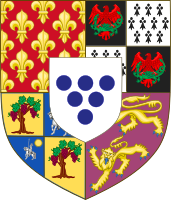 Shield of Normandie. It is used in most government institutions.
 -
 The coat of arms used exclusively by the lordships of Casse-glace and Lunhavre.
 -
 Crown of Normandy


.svg)

Ethnic coats of arms
Several ethnic groups in Normandy possessed coats of arms. These coats of arms had no official counterparts in Normandy. Kernevonia is an exception, as its coat of arms is incorporated into another Norman coat of arms. Many ethnic groups had their own unique coats of arms, but over time, information about them has been lost. Currently, only the Kernevons, Austrmarkers, Karumites, and Iridians have their own coats of arms. The coat of arms on the flag of Durntkinstan, contrary to popular belief, was not the coat of arms of Durntkinstan. The Varjans, however, widely use a coat of arms attributed to the real prehistoric Varja.
The Kernevon coat of arms emerged during the Purification of Normandy and became widely used among the KVGs. After the war, the Kernevon coat of arms was incorporated into a variation of the Norman coat of arms. The Austrmarkers presented a coat of arms in the early 1750s. This coat of arms is not widely used in social life.
-
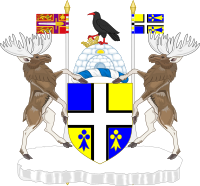 Coa of Kernevonia
 -
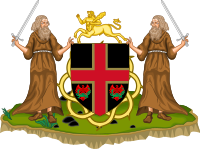 Coa of Austrmark


