Raspur Khanate
| Khānāt-e Raspur | |||
| |||
| Motto: Blood Calls Out for Blood | |||
| Anthem: Behold, the New Dawn Rises! | |||
| Location of Raspur | |||
| Map versions | N/A | ||
| Capital | Raspur | ||
| Largest city | Raspur | ||
| Official language(s) | Babkhi (official) Khalypsine and Vey Greek most commonly spoken | ||
| Official religion(s) | |||
| Demonym | Raspuri | ||
| - Adjective | Raspuri | ||
| Government | Restricted franchise elective monarchy | ||
| - Khan | Tahmaseb II Osman | ||
| - Grand Vizier | Azardokht al-Osman | ||
| - Legislature | Durbar | ||
| Establishment | 07 June 2016 | ||
| Area | N/A | ||
| Population | 49,801 Citizens 1,237,091 Protected Persons 2,818,391 Slaves | ||
| Currency | Dinar | ||
| Calendar | |||
| Time zone(s) | |||
| Mains electricity | |||
| Driving side | |||
| Track gauge | |||
| National website | |||
| National forum | |||
| National animal | Mardyakhor | ||
| National food | Long Pork | ||
| National drink | Narcotic Wine | ||
| National tree | Cedar | ||
| Abbreviation | RUR | ||


The Khanate of Raspur is a wiki-based simulated state set on the continent of Eura in the wake of the destruction of the Kingdom of Babkha. It considers itself to be a successor to the cultural identity (theme) of Babkha and also the short-lived Theocracy of Khalypsil, but in neither case to the polities themselves.
History
After the Apocalypse
Foundation
In theory, the Khanate was an elective monarchy, however the franchise was limited to a Durbar comprised of the House of Osman and the Houses of the Satraps, named for their provinces, with the hereditary Grand Vizier bringing the membership of the Durbar to nine.
It was a curious system of government where the seven were obliged to elect the man in whom resided the absolute power of life and death over them. The House of Osman has preserved itself in this precarious position solely by virtue of possessing the ruins of the Babkhan capital, although it might also be notedthat none of the other houses could abide the thought of one of their rivals acceding to the flayed-skin throne.
The hereditary Grand Vizierate, the institution which had been responsible for the limited reconstruction of Raspur before the establishment of the Khanate, was retained and made responsible for carrying out, in the Khan's name, the rudiments of public administration, the maintenance of roads and sewers, the taxation of the common folk, the culling of the bandaka and such like.
The single greatest item of expenditure for the government of the Khanate was the funding of the battalions of Immortals tasked with defending the person of the Khan and the seat of his government in Raspur.
Outside of the capital district, which remained firmly under the direct control of the House of Osman, the territory of the Raspur Khanate was divided seven-fold between hereditary governors, known as Satraps, who enjoyed absolute power in their dominions save the fealty that they notionally owed to the Khan. That same Khan could in theory have, at any moment, had called issued a firman for their destruction and they would have been obliged to bare their necks for the stranglers noose.
It was an unhappy system that rested upon the continual inward flow of slaves and plunder as well as outward flows of crude oil and raw opium to sustain itself.
Changes in government
Geography
Administrative divisions
The seven satrapies (Ostan) are:
- The Ostan of Arslan
- The Ostan of Farzan
- The Ostan of Mihran
- The Ostan of Mitra
- The Ostan of Suren
- The Ostan of Varaz
- The Ostan of Zjandar
Government and politics
Government
Foreign relations
Formerly an unrecognised state, the Raspur Khanate had no formal relations with foreign powers, and indeed in its values and conduct is considered to be actively antagonistic towards the wider international community. Contacts were however established with the Neo-Babkhan communities of Benacia, especially the Shirerithian branch of the House of Osman.
Military
The Khanate relies entirely on repaired and reconditioned Babkhan military equipment recovered from the myriad of bunkers and arms depots lost under the desert fastness of the irradiated wastelands. The military organisation of the Khanate similarly reflects the legacy of that vanished Euran empire.
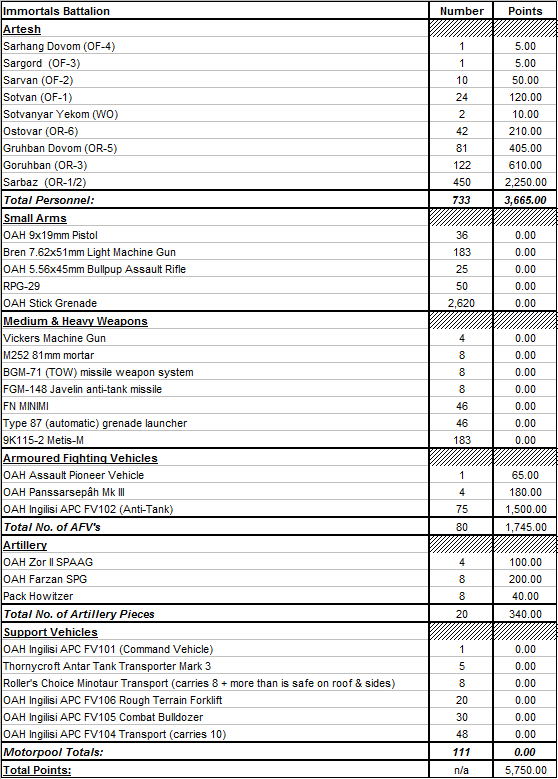
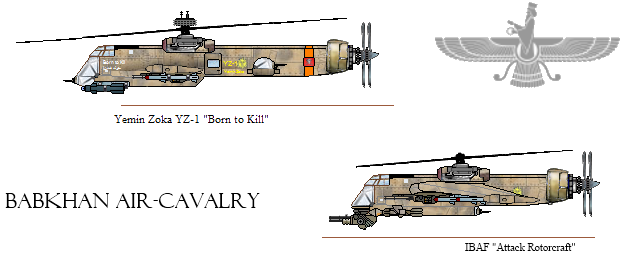
The Immortals are the Khan's pledged fidai, sworn to live and die in his service. They are the instruments of his rule. Eight battalions of the Immortals were raised, one to provide for the defence of Raspur and the person of the Khan, and the remaining seven garrisoned in the territory of his Satraps, to ensure that they are aware that they are never for a moment free from his reach. The Khan also enjoys the services of two salvaged attack-rotorcraft, commonly known nowadays as Whirdlebirds after the Minarborian fashion, with which he delights in leading personal raids on those wretched villages and nomad bands of the interior who have been tardy in paying the tribute that is his due.
The Diqhan, raised from the descendants of Euran nobility, are pledged to the service of the Satraps in whose name they were recruited and to whom their oaths have been given. The Diqhan battalions are both the bodyguards and the private armies of the Satraps and it is never entirely unheard of that they make war upon each other as much as they do upon the enemies of the Khanate. That Khan tolerates this fratricide, so long as it remains within tolerable bounds, as it keeps his subordinates fractious, suspicious and weak.
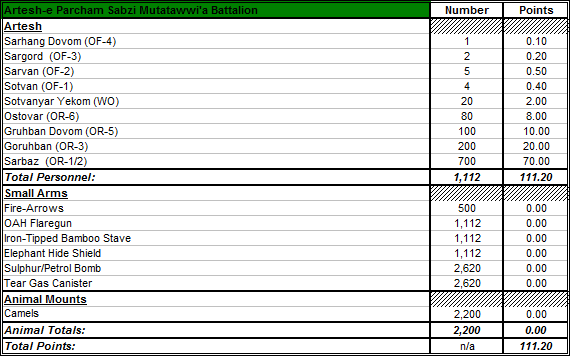
The Mutatawwi'a are religious troops who, inspired by their Zurvanist faith, have volunteered to fight. Untrained, reckless and fanatical, these troops are poorly equipped with primitive and improvised weapons. These wild warriors are more of a mob than a disciplined unit, eager to get into hand to hand combat with their enemy no matter the odds.
- Jundekhan (Companions of the Khan)
- The Division of the Immortals
- Immortals (x8 battalions)
- Air Support Group (x2 Whirdlebirds)
- The Division of the Immortals
- The Artesh-e Parcham Sabzi (Green Banner of the Army)
- The Division of Arslan
- The Arslanid Diqhan (x1 battalion)
- Mutatawwi'a (x6 battalions)
- The Division of Farzan
- The Farzanid Diqhan (x1 battalion)
- Mutatawwi'a (x6 battalions)
- The Division of Mihran
- The Mihranid Diqhan (x1 battalion)
- Mutatawwi'a (x6 battalions)
- The Division of Mitra
- The Mitraid Diqhan (x1 battalion)
- Mutatawwi'a (x6 battalions)
- The Division of Suren
- The Surenid Diqhan (x1 battalion)
- Mutatawwi'a (x6 battalions)
- The Division of Varaz
- The Varazid Diqhan (x1 battalion)
- Mutatawwi'a (x6 battalions)
- The Division of Zjandar
- The Zjandarid Diqhan (x1 battalion)
- Mutatawwi'a (x6 battalions)
- The Division of Arslan