Floret
 A Floret in the livery of its launch operator, El Kal. | |
| Type: | Civil turboprop transport aicraft |
| Manufacturer: | Kalavia Fixed-Wing Works, Gravelbottom |
|
| |
| Range | 8,000km |
| Maximum Speed | 720km/h |
| Altitude Ceiling | 11,000m |
| Minimum Required Runway | 2,000m |
| Maximum Payload Weight | 22 tonnes |
| Passenger Capacity | 104 |
The Floret is a civil transport aircraft produced by Kalavia, a unitary enterprise of the Kalgachi government.
Development History
Between 159 and 193 AL the Jingdaoese-made Jan-van-Gent VII had provided Kalgachia's only means of foreign cargo shipment outside the grasp of Raspur Pact interference. So important were these aircraft considered that the Kalgachi government paid far over the market rate for their purchase and willingly offered their manufacturer, Sokoku Industries, an exhorbitant maintenance contract. The payments required by the arrangement would eventually amount to the Kalgarrand equivalent of one tonne of gold bullion per year for 45 years, far exceeding the rest of Kalgachia's foreign trade turnover combined. By 204 AL, with rail links established to Batavia, the Jan-van-Gent contract became untenable in the eyes of Kalgachia's Directorate of Labour and Economic Planning and was quietly abandoned.
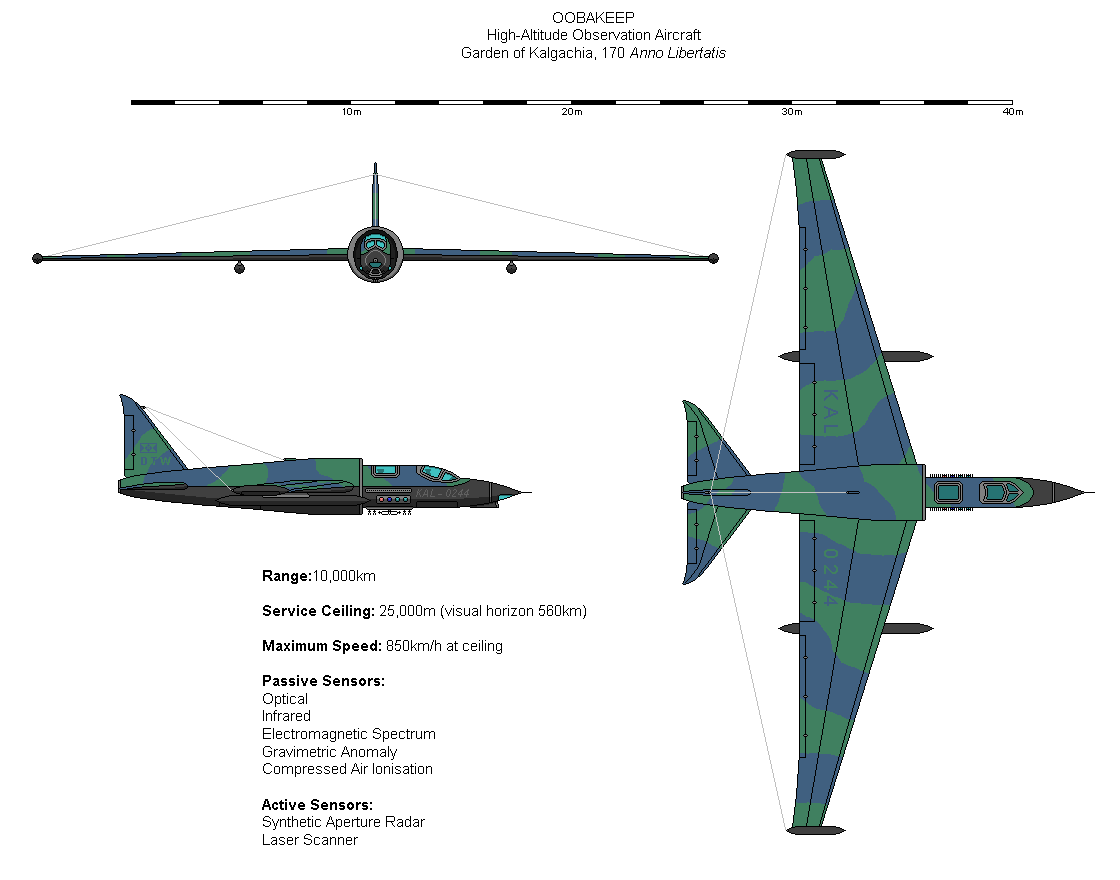
While the new rail links largely solved the problem of freight shipment, ideas began to circulate around the draughting rooms of Kalavia, Kalgachia's only aircraft manufacturer, for a cheaper domestically-made transport aircraft that could be used for miscellaneous duties such as the fast shipment of high-value cargoes or passengers. Although authorised by Kalavia management, the resulting design project languised for a number of years behind more important priorities such as the mass production of Whirdlebirb helicopters and the technical refinement of the Oobakeep reconnaissance aircraft; a natural consequence of Kalavia's status as a wholly-owned unitary enterprise of the Kalgachi Defence Force. Only after 215 AL did the necessary development resources become fully available and a name, Floret was assigned to the project.
Coming from a manufacturer inexperienced in fixed-wing transports, the emerging Floret inevitably came to resemble a fusion of Kalavia's previous engineering experience with that of the civil aeronautical cadre at El Kal. The undercarriage and empennage were duplicated wholesale from the Jan-van-Gent, the engines were a hybrid of the Whirdlebirb's turboshaft engine and the high-power turbojet to which it had been modified for the Oobakeep, and the counter-rotating propellers were run from a modification of the Whirlebirb's coaxial rotor drive. As many of the required components had been fabricated and tested in Kalavia's workshops during the Floret's long gestation - often without explicit permission - their incorporation in the prototype airframe was accomplished with unexpected ease.
The Floret's first test flight was successfully carried out in early 217 AL. The only significant problem noted was the feeble power of the elevators which, combined with a rear undercarriage somewhat aft of the aircraft's fully fuelled and loaded centre of gravity, required a significant and sustained effort by both pilots to rotate the aircraft for takeoff - the same problem created a tendency for the nose to fall heavily on landing. The aircraft's more agreeable characteristics included a good climb rate, an impressive speed which approached that of a turbojet in cruise configuration and responsive ailerons and rudder which offered manoeuvrability in tight traffic patterns. Old Jan-van-Gent pilots undergoing conversion training on the first production Florets rated its handling to be considerably smoother and more agile except in turbulent air, to which its lighter airframe was more susceptible.
El Kal took delivery of its first Floret in late 217 AL and is, to date, the aircraft's only operator.